D
Deleted member 19066
Guest
Hmm yes I also want to know, perhaps you can ask the civiliansI want to ask, what does the civilian(s) do in a monster infested forest???

Hmm yes I also want to know, perhaps you can ask the civiliansI want to ask, what does the civilian(s) do in a monster infested forest???

Memo Title: Metals & Minerals
Memo Category: Materials
Materials are everywhere and used for everything. They appear in all shapes and sizes, thus documentation of them is necessary. It'd be bad to come across a valuable ore and have it be mistaken for trash.
Metals:
Material:
Properties:
Uses:
Reference:
Iron
It is strong, malleable and ductile.
It has a lot of uses: Weapons, Armour, Furniture, Tools.
Silver
It is rare, valuable and brittle
UNKNOWN
Discovery + Rare Rating, Valuable + Brittle
Gold
UNKNOWN
It is mainly used for currency in this world.
The Currency: G
Minerals:
Mana Glowstone
It is a shiny crystal.
It's only use so far is to fuel mini portable batteries. Some low quality crystaks can be found at the river.
Location + Abundance of Glow Stone, Mini portable battery, Low Quality
Amethyst
It is a purple crystal, it is rare.
UNKNOWN
Discovery + Rare Rating
My Libary post just got fucked in the ass by @ohko 's.This isn't really a library entry, but I couldn't think of a better place to put it. I'm sorry!
Ohko's Guide to Semi-Realistic Bronze Age Smithing
For Dummies (and Authors)
Introduction
So you want your character to do smithing? But you have no idea where to start? This guide provides an overview of some methods of metalworking used on Earth. Feel free to use this as a reference for your writing... or not!
Adventurer's Guild is a fantasy roleplaying game, and there's no need to be realistic.However, if you want to add a touch of realism to your writing, I hope this resource can help! While I'm not an expert on this subject by any means, I'm a total geek on primitive technology — so take whatever you like from this!
Ores, Metals, and Alloys
In this section, I will discuss the seven classical metals of antiquity: Iron, Copper, Lead, Tin, Silver, Mercury, and Gold.Of these seven metals, only gold and silver are found in their native (elemental) form. The remainder are all usually found as rock-like ores, which mean that they are chemically fused to another element (e.g. iron oxide). Ores need to be smelted in order to purify them into their native (elemental) form.While native metals are great, they aren't always particularly useful for a metalworker trying to forge armor, swords, or tools. All of the native metals (except iron) are generally quite soft and easy to melt in a fire. Think of copper wire, tin cans, gold foil... they are easily bent and useless as a weapon.In order to change the properties of metals, they are often mixed with something else to create an alloy. Alloys can have have different useful properties such as increased stiffness, flexibility, density, strength, or even rust resistance.
Where to Find Ores?
Iron Copper Lead Tin Silver Mercury Gold 4.1% Earth's Mass 50 ppm 14 ppm 2.2 ppm 0.07 ppm 0.05 ppm 0.001 ppm Grey / Red / Brown Green / Grey Grey / Black / Silver Black / Grey Grey / Silver Bright Red Gold 1538 °C 1084 °C 327 °C 231 °C 961 °C -39 °C 1064 °C
In order to understand where to find ores, it is extremely helpful to know the relative abundance of different metals.Iron ore is extremely common. In fact, any kind of slightly reddish rock probably has some iron in it. This probably means that your backyard has iron! The question is, how much? Do the rocks in your backyard have 10% iron? 15% iron? Should you call a mining company and get rich???For practical reasons, we call something an "ore deposit" if the rocks in the area contain enough metal content for it to be profitably extracted. In the modern day, we have a lot of fancy tools that allow us to calculate the metal content of various rock. As a result, on Earth we often see mining companies set up shop in areas where they're drilling straight into ground to mine tons of plain-looking grey rock...However, in the ancient days, humans didn't have access to fancy tools. People depended on the color of rocks (and other things) in order to identify ore. It was easiest to see bands of rocks (an "ore vein") in sedimentary layers of the earth that were displaced, such as on cliff-sides or exposed mountains. If humans spotted an unusual color, perhaps there was metal ore there!
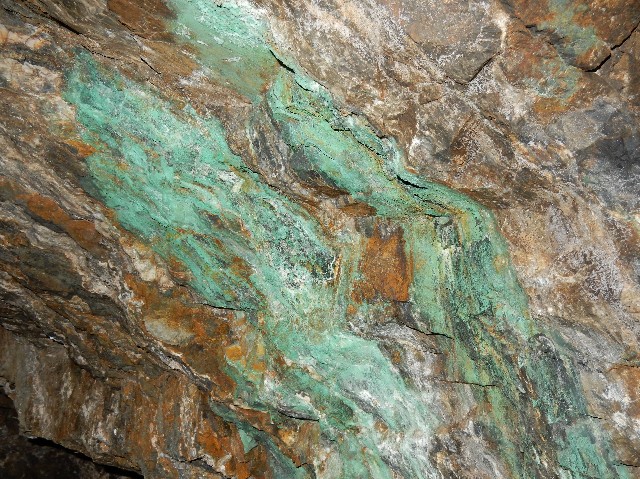

Once the original surface vein was discovered, it's only the tip of the iceberg!
Much of the vein continues underground!
If you have good mining skills, you can start digging shafts to follow the veins. Miners do not dig randomly. They follow the color of their rock.
A Brief History of Early Metals, Copper, and Bronze
Due to the distinctive color of malachite, copper was probably one of the earliest metals to be worked by humans. Very few other ores/metals (except cinnabar and gold) have such a distinctive color, so they could have only been discovered by blind accident.Fortunately, most of the metals of antiquity (except iron) have a low melting point.Lead and Tin are excellent examples. Both ores have low enough melting points (327 °C) (231 °C) that they can be smelted in an ordinary campfire. In fact, this was likely the way these metals were discovered. Someone left a bunch of grayish rocks in the village campfire, and a couple hours later they saw that the rocks had melted into this shiny stuff. Weird!
 Smelting copper is a bit more challenging with its higher melting point (1084 °C). Copper, Silver, and Gold could not be smelted in an ordinary campfire (max campfire temperature ~900 °C). Instead, humans needed to invent a new method to raise the temperature higher enough to melt these metals.

The problem with a metal like copper is that it is simply too soft. Although copper was abundant (and shiny and pretty), it was not practical for making any tools by itself.To harden copper into something stiffer, humans discovered a few copper alloys:
- 88% Copper + 12% Arsenic = Bronze
- 88% Copper + 12% Tin = Bronze
- 65% Copper + 35% Zinc = Brass
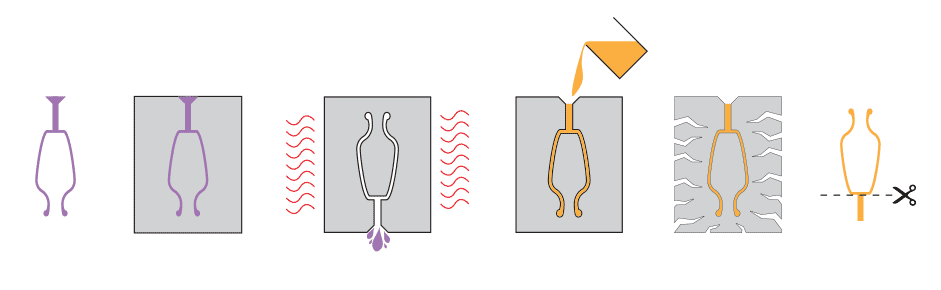
All of these copper alloys are predominantly copper (~90%) plus a trace amount of a stiffening metal. Increasing the fraction of the stiffening metal generally makes the resultant metal harder (yet also more brittle). For example, raising the concentration of tin in bronze results in a harder/sharper sword, but it is more likely to shatter.Casting bronze is fairly simple. By heating the appropriate proportions of copper and alloy in a crucible, molten bronze was created. Molten bronze would then be poured into a mold, typically made out of packed sand or clay. Advanced shapes could be created using fancy methods like Lost Wax Casting. This method entailed (1) creating a shape out of beeswax, (2) using the beeswax as a template in the mold, (3) melting the beeswax, and (4) pouring the bronze.Generally, bronze age tools and objects were all creating by casting, not hammering (like iron).After casting a tool, it would often be "finished" with extensive amounts of grinding, sanding, and other final touches. Bronze can be "work-hardened" (e.g. hammering) to a limited extent, but it is much more brittle than iron. If pushed too hard, it will shatter. Bronze swords were known to shatter on the battlefield in antiquity. This was in contrast with iron/steel swords which were less likely to shatter.It should be noted that bronze swords were often regarded as superior to wrought iron swords particularly in the Early-Middle Iron Age. The quality of wrought iron was highly variable in the early period and often full of impurities. Bronze often produced higher quality products and high-tin alloys were a harder metal than wrought iron. Additionally, bronze does not rust.

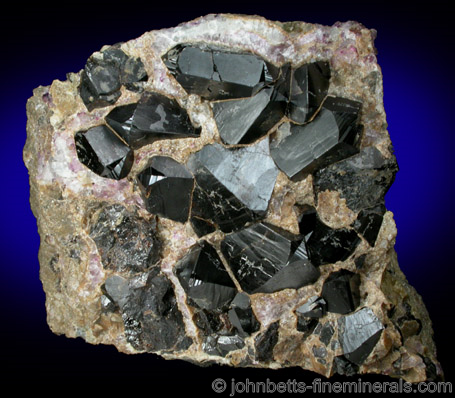
 The Iron Age eventually overtook the Bronze Age primarily economic reasons.The primary tin ore of antiquity was Cassiterite, which has a distinctive black crystalline appearance. However, it was extremely rare and found in only a handful of regions across the world. Notably, the entirety of the Middle East lacked a major source of tin.This is ironic because the most Bronze Age civilizations: Anatolia (Turkey), Egypt, Mesopotamia, Greece, India, and Central Asia all lacked their own regional sources of tin. Trade with faraway countries was critical for the bronze economy, which meant that a handful of powerful countries monopolized bronze production. When trade routes shut down, military economies were paralyzed and countries were left extremely vulnerable to their enemies.Iron — in contrast — was everywhere (4% of the Earth's surface). When metallurgy technology advanced to cover iron, the democratization of military weapons resulted in regional upheaval that drove the Late Bronze Age collapse. Suddenly, formerly "irrelevant" barbarians and raiders in backwater countries could field armies of massed infantry larger than ever before, overwhelming the smaller elite forces of Bronze Age charioteer nobility.

Epilogue
In conclusion, this article summarized basics of metallurgy relevant to the Bronze Age period.I'm tired for today, so I will stop here. I hope people did not find this excessively dull or useless.Next time, I will pick up with Iron Age metallurgy~

Herbs what I had in mind. But there’s also other things like tea in the mountain.Okay. I am reading the quest Forest Ranger. I want to ask, what does the civilian(s) do in a monster infested forest??? Gather herb? They better ask adventurer to do that. Hunting game? A hunter won't lose in the survival ability compared to adventurer, if their livelihood is from the forest.
What's the object of interest? Is there a special destination that is available on the map?

Hey. The market was already there before I point that out. I also said that the market should be part of the role play for people that actually care for the money value. I will never expect that everyone will care about the money and there will be some that will pile up a lot of money because he is either lazy or his character trivialize living expenses. I just don't want this kind of people suddenly decide "Hey, why I don't spend all this money for a joke and ruin people fun with money" or "I can produce infinite money with my character so let me share with it with everyone".These are all really fantastic comments and I don't really have that much to add.
Since I'm a relatively action-oriented person, why don't I make a suggestion?
What if we got rid of the "daily cost of living is 10G" line on the registration page?
By getting rid of this line, the message I'd like to send is that characters should deduct money whenever they feel like it. If they want to play a hardcore game, they can deduct every "in character day" for living expenses. If they want to play a casual game, maybe they can just forget about living expenses entirely. If you want to play something in between, you can deduct every IRL day... it's totally up to you and how you want to tell your character's story.
I agree with @Silver that money is ultimately just a tool for the writers, and originally there was never even a market thread or in-game function for money. The market thread was added in part because @SpearOfLies pointed out it would be strange if characters collected giant piles of money and never used it. Nonetheless, my original philosophy in the very beginning was that players could just deduct/nerf their own money whenever they feel like it... although in practice, I think most people are too stingy to nerf their own money.
In either case, I can definitely see both sides, and I'd like to make AG enjoyable and approachable for as many people as possible!
A fellow blacksmith! Welcome! :D
CHARACTER SHEET
APPEARANCE View attachment 1891
SKILLS (Refining)
Bludgeoner Nasseus is slim on the surface, but possesses surprising strength. Strength that he had spent years training to obtain. Once, the God of Greater Flames, Fradyr, took up a mortal vessel and challenged Nasseus to a sparring match to see into the depths of his strength. Unfortunately for the prideful god, the Nū-Hyme would manage to beat him senseless with his favorite rune-inscribed stick, leaving him unconscious on the ground, face flat on the floor. Fradyr would later claim that his loss was due to his inexperience with using inferior bodies.
Level 1
Increases proficiency with bludgeoning weapons. Allows use of bludgeoning arts.
No bludgeoning arts available as of yet.
Concentration
Nasseus is a scholar at heart and mind. He is often seen reading book after book in the grand archives of the heavenly palace, undeterred by the gods that grew worried about his health. Even in the presence of a nigh-omnipotent being begging him to eat his dinner, his focus would not break. His studies would continue late into the night.
Level 1
Increases efficiency of actions when concentrating. Mental ailments are cured when skill activates and are resisted while the skill remains active. Consumes stamina over time.
Craftsman Nasseus always had some incredibly useful tools hidden away in his pockets. Many gods of the pantheon often wondered where he had gotten them from. Only a few of them knew that all of his belongings were his creations.
Level 1
Increases the quality of items produced by Nasseus.
Elementalist
Nasseus quickly understood upon coming to the world of Tonia that they would no longer be able to utilize the Breath of Nū to create miracles as they had before. To protect himself and Mayari from harm, he needed a new power to wield against his foes. Eventually, he was taught of the existence of elemental magic and strove to learn and master it.
Level 1
Allows Nasseus to cast wind magic. The magic's effective power is proportional to the amount of mana consumed in casting the spell.
Footwork Nasseus's fighting style had always been a little strange. When he had once fought Fredyr, the God of Greater Flames, in a sparring match that the prideful god donning a mortal vessel had challenged him to, many were confused at the sight of the battle unfolding. For whatever odd reason, Nasseus constantly shifted up, down, and about in place, using some strange footwork while keeping Fredyr at a distance. Watching him move in such a peculiar manner made many gods spectating the scene grow nauseous. Before they could even realize it, the battle was already over, and Fredyr was already sprawled across the floor, face flat on the ground.
Level 1
Increases agility. Enemies focused on Nasseus gradually become more and more nauseous over time. Consumes stamina over time.
Siphon
One day, Nasseus began to wonder if he could make use of the divine paths (the pair of horns that grow around his ears) in the world of Tonia. Initially, he had thought that the absence of a connection to the Breath of Nū would turn his horns into useless ornaments atop his head. However, upon attempting to utilize the divine paths, he realized he could use its original ability to take in power from the Breath of Nū to instead absorb the mana in his immediate surroundings. Although the absorption process would cause him great pain, he found that this technique he had created was incredibly useful.
Level 1
This technique allows Nasseus to slowly absorb the mana in his surroundings, regardless if they originate from a friend, foe, or inanimate object. The affected targets, including Nasseus, will feel excruciating pain in the process of the absorption.
BASIC INFORMATION
Name Nasseus Horrune Age 23 Race Nū-Hyme Gender Male Class Artificer Level 1 (0/200 EXP) Money 500G Personality Loyal, Studious Likes History, Magic, Mysteries Dislikes Boats, Dogs, Milk
DETAILED INFORMATION (Refining)
Description & History Nasseus Character Overview
Nasseus's Village Life
- Nasseus is a talented artificer, scholar, and a servant to the Gods of Nū.
- He has an insatiable curiosity for the unknown and wished to uncover the secrets of the world.
- To further his research of the unknown, he learned to create artifices to aid him in his research and inevitably drew the attention of the grandmaster of Macydonis's great academy.
- His research in Nhostre theology drew the contempt of the church, prompting him to leave the academy to further his research elsewhere. He would then travel the lands to study the ruins of ancient civilizations.
- During his travels, he would happen upon a self-proclaimed nobleman whom he would provide aid to. The two became close friends and would travel together for quite some time. Nasseus would eventually uncover the man's facade and find that the man was, in fact, the king of gods.
- The god whom Nasseus befriended invited him to work in service of him. Nasseus requested that in exchange for his services, he would receive compensation. The god agreed to his terms, and promised to aid him in his research. And so began Nasseus's many years of service to the pantheon.
- Nasseus served as a watcher of the lower realms. The lower realms of Nū, unbeknownst to the ignorant mortals who knew not of the circumstances endangering the world, was constantly under threat of the foreign forces that sought after the world's heart, unceasing in their attempts at breaching the Greater Border.
- The fall of Nhidia, the Goddess of the Greater Border, signaled the end of the pantheon. Horns were blown, and thus a war on a scale never seen before had started in favor of the invaders. The Queen of Ylissaia, who foresaw their loss, tasked Nasseus with the protection of her beloved daughter, Mayari, and sent them to another world.
Nasseus's Academy Life“They say that the sky is endless, but is that really true?”
Nasseus, as a child, often looked up to the sky and pondered this question day by day. He was a curious child, one that took after his esteemed father, Molnar Horrune, who was a great sage once upon a time. He spent his days indoors in his father’s study, reading through his father’s grand collection of books that piled up in small mountains. His mother, Ephima Horrune, often worried for her son, who chose paper and quill over playing with the neighborhood children of the village.
Nasseus earned himself a surprising reputation as a young and talented, but sheltered, artificer. The boy’s studies that he had conducted in his father’s study everyday required the aid of tools for his experiments. However, Nasseus could not trouble his worried mother with any more burdens than she had already borne, so instead, he took the challenge head on and made artifices of his own design to aid him, eventually earning him fame.
Artifices are tools that drew power from the Breath of Nū, the energy from which all life springs from, to create miracles that simplified the cumbersome processes of day-to-day life like starting fires and cooling water among other things. They also made for powerful weapons, so for the nobles of the kingdom of Macydonis that led private armies to protect their territories, artificers were invaluable. So when word came to the capital that a genius artificer lived in a backwater village at the border of the kingdom, many were quick to extend their hands to the boy had yet to reach adulthood.
Nasseus had no interest in becoming a tool to the nobility, so he ignored their invitations and continued his days in his father’s study. Or at least, that was the case until a letter written by the grandmaster of Macydonis’s great academy, Zynnu Lattiere, came for him. Ephima, who wanted her son to have nothing to do with the arcane, was not pleased by the contents of the letter.
The letter from grandmaster Zynnu explained that he would grant Nasseus a scholarship, a room in his mansion as his living space, and many other benefits should he decide to enroll in the great academy of Macydonis. Many of the things listed on the letter didn't catch the boy's interest, however, one thing certainly did. Access to the academy's library.
Nasseus's Journeys
Nasseus's Service to the Gods
The End of Nū
Race Information Nū-Hyme
The Nū-Hyme are a race of intelligent humanoid creatures that had existed in the world of Nū long before the gods that would make up the pantheon descended upon the world. They're mortal and look like humans. While there aren't many differences between the regular humans of Tonia and the Nū-Hymes of Nū, one defining key feature that differentiates a Nū-Hyme from a human is the pair of small horns that grow around their ears that serves as divine paths that allow them to absorb power from the Breath of Nū and utilize it for their benefit.
Class Information Artificer
Nasseus has a passion for the mysterious and the unknown and wishes to learn all the secrets of the world, but as a mere mortal who is inhibited by many factors that trouble his kind, such as food, water, shelter, and other things, it is unlikely that he will find all the answers he so greedily desires within his life span. So, in order to keep him as close to reaching his goal as possible, he had absorbed the skills of multiple crafting professions all in order to create items and tools to aid him in the cumbersome processes of his experiments, researches, and living his day-to-day life.
Tonia Relationships
Mayari
ClausNasseus considers himself as Mayari's guardian. After escaping the world of Nū with Mayari, he swore to himself that he would support her in place of her mother and worked to secure appropriate living space for the girl. He often treats her like a little sister, despite their incredibly large age gap. Mayari is not fond of his treatment of her.
Claus is Nasseus and Mayari's benefactor. Shortly after their transference into the world of Tonia, the pair who had nowhere to go met Claus, the intelligent chicken. Claus provided them food and shelter in exchange for their services at his inn. Nausseus feels deeply indebted to Claus. Even after becoming an adventurer and leaving Claus's "nest", Nausseus still drops by the Early Bird's inn to see Claus.
POSSESSIONS (Refining)
Wooden Staff A rune-inscribed staff of Nasseus's making that once channeled the Breath of Nū to produce phenomenons distinct to the world of Nū. After Nasseus and Mayari were transferred to the world of Tonia, the staff was reduced to a mere bludgeoning weapon.
Scholar's Cloak A cloak made for the scholars of Macydonis. Nasseus inscribed it with runes that produced convenient effects for the wearer to make donning the cloak significantly more comfortable. It no longer functions as intended. After Nasseus and Mayari were transferred to the world of Tonia, Nasseus began sewing multiple pockets of varying sizes into the inner side of the cloak so that he may carry around a multitude of items on his person.
Leather Bag A simple leather bag Nasseus purchased out of necessity. It's sturdy and water-resistant.
Bronze Carving Knife & Sheath A knife often used for carving wood and dismantling monster corpses. Nasseus rarely uses this in combat.
Bronze Hammer A must-have for every craftsman.
Wooden Canteen (x2) An essential item for travelers. Nasseus keeps one for himself and another for Mayari. Each canteen has their names inscribed onto their surfaces.

I would categorise blacksmiths and enchanters separately, otherwise you'd end up with tons of level 2 NPCs being able to use magic and making super powerful items.Are we going to have blacksmiths do magical enchanting of weapon thingy? Or are we going to have enchanters or something? What about non-weapon stuff?


If you use the Reply/Quote buttons, color does carry over.Although its unfortunate that colour does not carry over...
one player mentioned a summer so there might be seasonswhat is the official calendar system used in Tonia, @GM? I want to make a diary-like entry...

My character would be surprised, as my character was once a guild worker. How else we archive the quest? It would be strange if later another guild worker use a different calendar system to mine?There is no official system. It’s a shared world, so I wouldn’t be surprised if people had different ways of counting.

Just declare a system, the setting should be consistent.There is no official system. It’s a shared world, so I wouldn’t be surprised if people had different ways of counting.
My character would be surprised, as my character was once a guild worker. How else we archive the quest? It would be strange if later another guild worker use a different calendar system to mine?
Sorry, but this AG runs on a minimal "official" lore set.Just declare a system, the setting should be consistent.

Hewwo.A fellow blacksmith! Welcome! :D

*covers you in ink and sees you roll out the words: 'Willing to write for huggles'*
rolls around because am too lazy to write
Utopia, we should write something on medieval clothes like what ohko wrote for metallurgy.
rolls around because am too lazy to write