Writing How do I write a pre planned novel?

Supperset

Well-known member
Joined
Sep 21, 2023
Messages
151
Points
83
I want to write a novel with planning done ahead of it. Most of the time I just write on the fly without having an actual structural plot, I guess that's why my novel feel like schizophrenia mess. Please give a bit of advice.

I don't have a posted novel at SH at the moment.
 

SeaJay

Active member
Joined
Jun 24, 2024
Messages
71
Points
33
Just think about a character, a start, and a end. How do you want the story to end and where? Do the same for the start, and the way to the end. How and why will the character(s) get there? Then you get into that rabbit hole, and you're done. Think in a general outline - name a character, a plot idea, and then fill it in on your own time. It helps to have a strong story idea, a knowledge of its length and tone/mood, the names of the characters, world-building done in your head, and a general timeline.
At least that's how I do it...
 

Eldoria

Well-known member
Joined
Jun 14, 2025
Messages
1,606
Points
113
I can't give you any good advice: I've written four novels in a month and a half. And the result is that three of my carefully planned novels didn't get a positive response. In contrast, my first novel, born of spontaneity, received a positive response. I only thought of the first novel as a random idea that 'happened' to cross my imagination. But after further analysis, the first novel actually has a market segment in SH. The theme of mother-daughter parenting is a universal theme that is relatively easy to accept, even though SH prefers power fantasy novels. So what I can say is, don't throw away your wild ideas, don't immediately assume the market won't accept them, try researching whether your wild ideas are interesting, unique, and have a specific market segment in SH. If so, don't hesitate to write it into a novel. And who knows, maybe the novel will make an impression and impact on readers in SH. Regards.
 

Hans.Trondheim

Low energy is king!
Joined
Jan 22, 2021
Messages
1,939
Points
153
Might you want to check this; I'm a planner myself.

1754188859332.png


1754188885354.png


This is how I plan my works.
 

Sarandib

Member
Joined
Apr 11, 2025
Messages
19
Points
13
You should have some planning, because it makes things easier. Even if you aren't a planning-heavy person.
I like to loosely plan out the arc (starting point, climax, resolution) and that's it. When I write a chapter, I write a short summary of the events. All of this is subject to change, it's very loose, it just gives me something to write toward instead of flying in blind.
Some people like to plot out their story scene-by-scene, chapter-by-chapter. I think that's boring, but if it helps you then go for it.
For character stuff, writing it down might help. It depends on how many characters you have. I personally don't have a massive revolving cast, so I don't bother, i know the characters and their personalities in my head.
 

HisDivineShadow

Well-known member
Joined
Apr 22, 2025
Messages
312
Points
63
I don’t.
I’ve got an idea.
I know a few main characters, key turning points, and how it’ll end.
Everything else is improvisation.

Someone in the thread mentioned they outline their chapters beforehand
Don’t remember who exactly. Maybe they’ll pop in and share their method. But if your brain works differently, just do whatever works for you
 

ThisAdamGuy

Proud inventor of the chocolate onion
Joined
Sep 4, 2024
Messages
1,005
Points
128
Step 1: pre-plan your novel.

Step 2: write it.

Jokes aside, I'm not sure what else to tell you. That's literally all there is to it. Make notes ahead of time detailing what you want to happen in each chapter, and then write the book following those notes.
 

CharlesEBrown

Well-known member
Joined
Jul 23, 2024
Messages
4,594
Points
158
I generally use the same system that I was surprised to learn at least two comics industry professionals (Chris Claremont and John Byrne employ) - plan out the "big moments" (usually a "visual scene" - a big reveal, a large set-piece, or a plot-defining moment - the specific example they used was the moment when Darkseid approaches the Source Wall in the X-Men/Teen Titans crossover and somehow reaches across universes, triggering the following simple vocal exchange: "Who DARES Summon Dark Phoenix?" "I, Darkseid!").
Write out the details for those moments.
Put them in the order you need them to appear (if you're doing something non-linear, or including flashbacks this may be the toughest step, actually).
Write the material connecting them (through increasingly smaller moments).
 

KidBuu699

Well-known member
Joined
Feb 17, 2020
Messages
60
Points
58
Approach the issue with the idea of roads and bridges. What does a road and/or bridge do? They connect two points together.

So make a general idea of the major plot points/events that you want in the story. A good general way to do this is to come up the basic idea for each chapter/arcs you want to do. Not write the entire Arc just the main point.

Once you have the general outline of A, B, C, etc etc you can start making roads or bridges to connect them. So while you are expanding out from your general outline you should ask yourself questions like, "What needs to happen for my story to get from point C to D?" If point C takes place in America and point D takes place in Europe, how is my character getting there?

Also if you really get into this you can make bullet points underneath each of these points. So in point C you want this main event to happen but you also want this side character to be introduced. Does this side character help with the plot of point C or perhaps he is the one who helps the mc get to point D in Europe.

Everything else outside of the main points and any bullet points is just for you to have the mc naturally experience. Make it a guided mission you could say. He will get to the point you want, but what happens in between is up to what is happening in the moment.
 

Valmond

Stories are on Patreon
Joined
Oct 31, 2020
Messages
1,020
Points
153
There are different ways to do this, but the way I do it is as follow.

EX:

Chapter 1:

- Beginning
- Detail
-
-
-

Chapter 2:

- Detail
-
-
-
-

Chapter 3:

- Detail
-
-
-
-


Etc.

Mid point

- Roughly where the middle point of the story will be.

- Detail
-
-
-

Finale:

- End

- Final conflict

- Detail

-
-

The extra dashes are just details, scenarios, the idea that links into the ending. Your job is to use those scenarios for the end point.

I recommend planning the ending first, as that gives you the stopping point.

Now, details can change, stuff happens. However, the changes do not affect the overall plan.

Sometimes, what you have planned leads to a completely better idea at some point, and you should capitalize on it if such a moment comes.

Through the tight structure, establish what sort of relationship the characters have, how close they are to one another. The conflict, stakes, etc,

Essentially, write out a rough summary for each chapter, the type of relationships, maybe some dialogues to help steer the type of tone you intend to use.

These can no doubt change, but the point is that it is there to keep consistency.

It might not look like much, but I’ve ended up with plans 8k to 20k words before.

Essentially, what I do. Is chapter by chapter, once I have planned everything out.

I copy first Chapter 1 plan into the writing space, and ensure to label it as the plan. From there, I can quickly reference what I am doing.

Now, here comes the tricky part. It takes a lot of practice to pull off. The memory consistency.

No doubt, you run the risk of forgetting stuff. Personally, what I have done. Is skillfully weave trigger words that only I can spot into my style.

These words, the way it is strung together. To the reader, it expands the story, it grounds the characters, it creates the emotions, it tells the story in short.

It keeps moving, the stakes keeps rising. However, for me as the author. Within those words, are small beats that constantly jogs my memories, so I do not have to spend time going back and confirming this or that.

If I do make a mistake, it is almost always easy to fix with a line or two addition. This isn’t an easy skill to learn, took me years, countless errors.

Though, when it got going, everything became easier.

So, on one end you got the detailed plan. On the other end, the writing itself keeps you informed on how to proceed without backtracking much.
 
Last edited:

Supperset

Well-known member
Joined
Sep 21, 2023
Messages
151
Points
83
There are different ways to do this, but the way I do it is as follow.

EX:

Chapter 1:

- Beginning
- Detail
-
-
-

Chapter 2:

- Detail
-
-
-
-

Chapter 3:

- Detail
-
-
-
-


Etc.

Mid point

- Roughly where the middle point of the story will be.

- Detail
-
-
-

Finale:

- End

- Final conflict

- Detail

-
-

The extra dashes are just details, scenarios, the idea that links into the ending. Your job is to use those scenarios for the end point.

I recommend planning the ending first, as that gives you the stopping point.

Now, details can change, stuff happens. However, the changes do not affect the overall plan.

Sometimes, what you have planned leads to a completely better idea at some point, and you should capitalize on it if such a moment comes.

Through the tight structure, establish what sort of relationship the characters have, how close they are to one another. The conflict, stakes, etc,

Essentially, write out a rough summary for each chapter, the type of relationships, maybe some dialogues to help steer the type of tone you intend to use.

These can no doubt change, but the point is that it is there keep consistency.

It might not look like much, but I’ve ended up with plans 8k to 20k words before.

Essentially, what I do. Is chapter by chapter, once I have planned everything out.

I copy first Chapter 1 plan into the writing space, and ensure to label it as the plan. From there, I can quickly reference what I am doing.

Now, here comes the tricky part. It takes a lot of practice to pull off. The memory consistency.

No doubt, you run the risk of forgetting stuff. Personally, what I have done. Is skillfully weave trigger words that only I can spot into my style.

These words, the way it is strung together. To the reader, it expands the story, it grounds the characters, it creates the emotions, it tells the story in short.

It keeps moving, the stakes keeps rising. However, for me as the author. Within those words, are small beats that constantly jogs my memories, so I do not have to spend time going back and confirming this or that.

If I do make a mistake, it is almost always easy to fix with a line or two addition. This isn’t an easy skill to learn, took me years, countless errors.

Though, when it got going, everything became easier.

So, on one end you got the detailed plan. On the other end, the writing itself keeps you informed on how to proceed without backtracking much.
Thanks I will try to do that. ??
 
D

Deleted member 166465

Guest
I see we all use more or less the same method, with variations. I will give my 50 cents, but since I am not by any metric a succesufull writer, take it with a HUGE grain of salt. Now this si what I do:

I focus on the object of my main plot and the events: Let say a character, I give it name:

Willy? Yes, Willy: a yunkie, an addict hill billy, (becouse it rymes. Willy the hill billy). so, what happens to Willy? > he is a whitness to a military convoy been attacked, by armed forces. Is chaos. > the guys figthing almost kill each other, while billy is just there watching scared hiding in a pile of trash > then.. what?... ok ok got it. One of the attackers goes into a vehicle and bring out a box, but get killed by a wounded soldier that is dying. The soldier take the box and opens it, inside there is a Syringe and he is going to inject himself with it.
> Willy, the yunkie hill billy jumps out of the trash with the energy and strenght that only an addict is capable of, takes the soldier by surprise, steal the syringe and runs away, > a few km later in an alley, the yunkie get his dose, he feels his heart start pumping, the and intense chest pain and pass out. > willy wakes up later that day, he is stronger, faster, more focus and that Is how we get the tittle "THE SUPER YONKI HILL BILLY" (the hardest part is the fking tittle)
Now willy goes around beating the shit out of criminalls all around the city, busting drugs labs and stuff to get his fix, dude is doing so much drug that charlie sheen and ozzy would be proud of him. > Our hero cleans the city of drugs one neighborhood at a time, since he doesnt care about anything else he saves a bunch of ilegall migrants from china, that were shipped by the triads. He could smell it, a huge shipment of heroin, our hero dies of overdose when he uses a huge water tanks to burn the heroin, a garden hose and a copper pipe 1 cm thicc to deliver the drug into a vein in his neck.

See.. I just made all up on the fly, a weird ending, but an ending. I dont focus on chapters, I focus on events. there in the middle, after he gets his powers you can add a lot of fill by describing his drugs bust and what not.

I just read what I wrote... what the hell is this? Although if someone with a sense of humor can write it, it could be very funny. Too bad I am as funny as a root canal.
 

Placeholder

Well-known member
Joined
Nov 24, 2022
Messages
464
Points
133
> Most of the time I just write on the fly

Sketch out plot bits on separate index cards at a sensible level of granularity, set aside the ones you don't like and the ones that don't work.

Chain them together to make a narrative.
 

Arch9CivilReactor

Well-known member
Joined
Dec 24, 2021
Messages
365
Points
103
Open up GoogleDoc and keep a note on the things you’ve already written and might need. Especially plan the ending beforehand. Once you have a place to go, the rest will fit itself in.
 

Ai-chan

Queen of Yuri Devourer of Traps
Joined
Dec 23, 2018
Messages
1,668
Points
153
First choose which kind of structure you want.

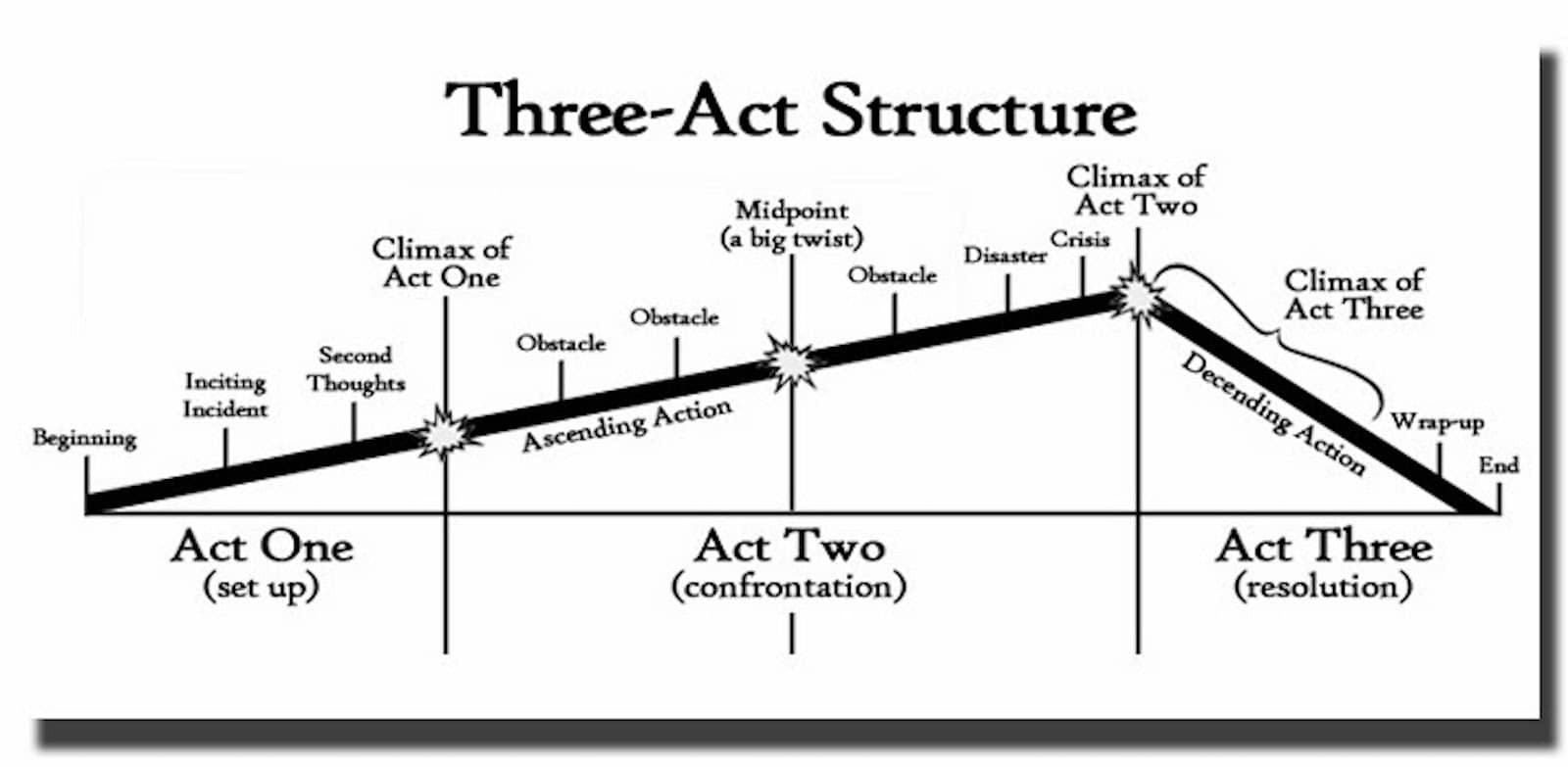
1. Three act structure - for those who can't handle structure.


Act I: The Setup (or Exposition)
This act introduces the main characters, their world, and establishes the initial conflict or problem that will drive the story. It also often includes an inciting incident that sets the protagonist on their journey. The first act typically takes up the first 25% of the story.
Act II: The Confrontation (or Rising Action)
This act focuses on the protagonist's attempts to deal with the established conflict, facing escalating challenges and obstacles. This is where the stakes are raised, and the character experiences both successes and setbacks. This act is usually the longest, taking up about 50% of the story.
Act III: The Resolution (or Falling Action)
This act brings the story to a conclusion, resolving the central conflict and showing the consequences of the protagonist's actions. It often involves a climax, where the conflict reaches its peak, and a resolution, where loose ends are tied up and the story finds its ending. This act typically takes up the remaining 25% of the story.


2. Five act structure - a better system for those who can handle self-discipline.


Exposition:
This initial act introduces the characters, setting, and initial situation of the story. It lays the groundwork for the narrative by providing essential background information.
Rising Action:
This act builds tension and conflict as the protagonist faces challenges and obstacles. It's a period of increasing stakes and complications that lead towards the climax.
Climax:
This is the turning point of the story, the moment of highest tension and drama. The protagonist confronts the central conflict, and the outcome is uncertain.
Falling Action:
Following the climax, this act shows the consequences of the protagonist's actions and the unraveling of the conflict. The tension begins to decrease as the story moves towards its conclusion.
Resolution:
The final act provides closure to the story, resolving any remaining conflicts and tying up loose ends. It offers a sense of completion and allows the audience to reflect on the journey.

3. Kishōtenketsu - eastern story structure for those 'what the fuck' or 'holy shit!' endings


Ki (起) - Introduction:
Establishes the setting, characters, and basic situation.
Shō (承) - Development:
Further develops the characters and setting, building upon the introduction.
Ten (転) - Twist/Reversal:
Introduces an unexpected element or event that shifts the narrative direction.
Ketsu (結) - Conclusion/Reconciliation:
Connects the twist back to the initial elements, often offering a harmonious or thought-provoking resolution.

 
D

Deleted member 166465

Guest
Preferably with words.
That was a punch line Leslie Nielsen would be proud of.
Open up GoogleDoc and keep a note on the things you’ve already written and might need. Especially plan the ending beforehand. Once you have a place to go, the rest will fit itself in.
This is very important for distracted people that lose their focus easily... oh look a squirrel.
 

Anaktoria

New member
Joined
Aug 3, 2025
Messages
8
Points
3
You should have some planning, because it makes things easier. Even if you aren't a planning-heavy person.
I like to loosely plan out the arc (starting point, climax, resolution) and that's it. When I write a chapter, I write a short summary of the events. All of this is subject to change, it's very loose, it just gives me something to write toward instead of flying in blind.
Some people like to plot out their story scene-by-scene, chapter-by-chapter. I think that's boring, but if it helps you then go for it.
For character stuff, writing it down might help. It depends on how many characters you have. I personally don't have a massive revolving cast, so I don't bother, i know the characters and their personalities in my head.
This is exactly how I do it too! I love this approach because it gives you this wonderful balance between flexibility and guidance. It's like pinning your sewing or having a sketch before you paint - all the fun for me is figuring out the details, which motivates me to keep writing, but I have enough of a roadmap that I'm not going to be disappointed with the end result once I get there. Love this perspective.
 

CharlesEBrown

Well-known member
Joined
Jul 23, 2024
Messages
4,594
Points
158
First choose which kind of structure you want.

1. Three act structure - for those who can't handle structure.


Act I: The Setup (or Exposition)
This act introduces the main characters, their world, and establishes the initial conflict or problem that will drive the story. It also often includes an inciting incident that sets the protagonist on their journey. The first act typically takes up the first 25% of the story.
Act II: The Confrontation (or Rising Action)
This act focuses on the protagonist's attempts to deal with the established conflict, facing escalating challenges and obstacles. This is where the stakes are raised, and the character experiences both successes and setbacks. This act is usually the longest, taking up about 50% of the story.
Act III: The Resolution (or Falling Action)
This act brings the story to a conclusion, resolving the central conflict and showing the consequences of the protagonist's actions. It often involves a climax, where the conflict reaches its peak, and a resolution, where loose ends are tied up and the story finds its ending. This act typically takes up the remaining 25% of the story.


2. Five act structure - a better system for those who can handle self-discipline.


Exposition:
This initial act introduces the characters, setting, and initial situation of the story. It lays the groundwork for the narrative by providing essential background information.
Rising Action:
This act builds tension and conflict as the protagonist faces challenges and obstacles. It's a period of increasing stakes and complications that lead towards the climax.
Climax:
This is the turning point of the story, the moment of highest tension and drama. The protagonist confronts the central conflict, and the outcome is uncertain.
Falling Action:
Following the climax, this act shows the consequences of the protagonist's actions and the unraveling of the conflict. The tension begins to decrease as the story moves towards its conclusion.
Resolution:
The final act provides closure to the story, resolving any remaining conflicts and tying up loose ends. It offers a sense of completion and allows the audience to reflect on the journey.

3. Kishōtenketsu - eastern story structure for those 'what the fuck' or 'holy shit!' endings


Ki (起) - Introduction:
Establishes the setting, characters, and basic situation.
Shō (承) - Development:
Further develops the characters and setting, building upon the introduction.
Ten (転) - Twist/Reversal:
Introduces an unexpected element or event that shifts the narrative direction.
Ketsu (結) - Conclusion/Reconciliation:
Connects the twist back to the initial elements, often offering a harmonious or thought-provoking resolution.
Note that the 3-act structure is typically used in classical drama (plays and movies). The five-act structure is typical of television shows.
 
Top