
You are using an out of date browser. It may not display this or other websites correctly.
You should upgrade or use an alternative browser.
You should upgrade or use an alternative browser.
Trolley problem. Just that.
- Thread starter laccoff_mawning
- Start date

Anonjohn20
Pen holding member
- Joined
- Mar 22, 2023
- Messages
- 1,921
- Points
- 153
I would rather not hang around somewhere with chicks with dicks, and a princess that wanted to reward me personally...too confusing

Juia_Darkcrest
Neurotic Exorcist
- Joined
- Jun 9, 2025
- Messages
- 1,032
- Points
- 113
I will be remembered for many other things, being the king of the dickgirls doesn't need to be one of them LMAO
If they have time to patiently explain the answer to me, they have the time to solve it themselves. Anyone who dies because they did not deem to untie them is their responsibility.
D
Deleted member 266
Guest


bulmabriefs144
Well-known member
- Joined
- Apr 30, 2021
- Messages
- 278
- Points
- 83
The trolley problem is wrong-headed to start with. Basically, it has two unlikeable options, and basically encourages psychopathic thinking.
Instead of asking "how can we save the five?" it wants to bully you into being a murderer through action or being a manslaughterer through inaction. And then, we're supposed to rationalize murder as being okay for the "greater good". But it's not okay. Nor is sacrificing a fat man (not even sure why that's morally different from pulling the lever, tbh).
First of all, why doesn't the train have brakes? Or does it but they don't work?
Second, can you get off the train, and if so, maybe slow it down with your own death? Can you lay objects in front of the train? Can it be diverted to a third track? Can you warn someone that the trolley cannot stop? Are they really tied up (usually, they're just inattentive jerks and could be warned to move out of the way)? Can whoever tied them up be executed after rescuing them?
Nope, these questions are not addressed.
Electric stuff runs out of power rather immediately if the line is cut.
Instead of asking "how can we save the five?" it wants to bully you into being a murderer through action or being a manslaughterer through inaction. And then, we're supposed to rationalize murder as being okay for the "greater good". But it's not okay. Nor is sacrificing a fat man (not even sure why that's morally different from pulling the lever, tbh).
First of all, why doesn't the train have brakes? Or does it but they don't work?
Second, can you get off the train, and if so, maybe slow it down with your own death? Can you lay objects in front of the train? Can it be diverted to a third track? Can you warn someone that the trolley cannot stop? Are they really tied up (usually, they're just inattentive jerks and could be warned to move out of the way)? Can whoever tied them up be executed after rescuing them?
Nope, these questions are not addressed.
Electric car propaganda!On the track is a trolly. It is powered by electricity. It will never run out of power.
Electric stuff runs out of power rather immediately if the line is cut.
D
Deleted member 266
Guest

Alski
Stray cat
- Joined
- Jan 10, 2021
- Messages
- 1,459
- Points
- 153
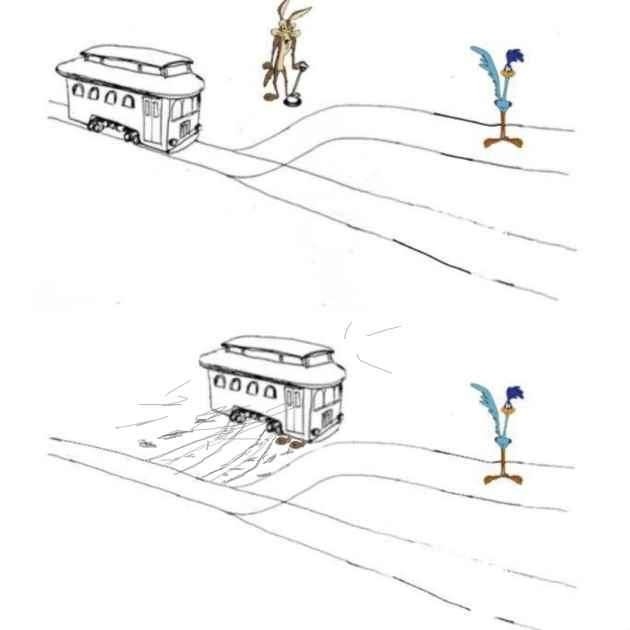
Meep meep.
D
Deleted member 266
Guest


laccoff_mawning
Well-known member
- Joined
- Oct 26, 2022
- Messages
- 500
- Points
- 133
I would disagree. It's a problem posed to challenge moral views.The trolley problem is wrong-headed to start with. Basically, it has two unlikeable options, and basically encourages psychopathic thinking.
Yes, it doesn't ask about how we can save the five. No, it doesn't want to bully you into becoming a murderer. It simply wants an answer. An answer that most people are reluctant to give and will try and sidestep around.Instead of asking "how can we save the five?" it wants to bully you into being a murderer through action or being a manslaughterer through inaction. And then, we're supposed to rationalize murder as being okay for the "greater good". But it's not okay. Nor is sacrificing a fat man (not even sure why that's morally different from pulling the lever, tbh).
It wants to ask what it asks: Do you kill one to save five or do you not? That's it. At the fundamental level, that's all it wants to ask.
And a large majority of people don't seem comfortable confronting that question. So they like to ask things like this:
First of all, why doesn't the train have brakes? Or does it but they don't work?
Second, can you get off the train, and if so, maybe slow it down with your own death? Can you lay objects in front of the train? Can it be diverted to a third track? Can you warn someone that the trolley cannot stop? Are they really tied up (usually, they're just inattentive jerks and could be warned to move out of the way)? Can whoever tied them up be executed after rescuing them?
Nope, these questions are not addressed.
But these questions are the actual distractions to the problem. If you want, we can just be more explicit and construct a scenario where these things are impossible. We're behind a glass wall and can't interfere with the tracks or the trolley. The trolley is unmanned, and cannot be controlled remotely. Yes, 'tied up' actually means 'tied up'. The legal consequences are unknown to you and will be unknown to you until after the event is over.
But even in this scenario, I'm sure we can consider more things to do than simply pull the lever or not. However, the question remains; when all else is tried and all else fails, for one reason or another, the moment comes when we must make a decision. What do we choose then?
Now, shall we face the problem head on and decide, or shall we continue asking more of these questions in an attempt to dodge the real question that it's asking?
bulmabriefs144
Well-known member
- Joined
- Apr 30, 2021
- Messages
- 278
- Points
- 83
Except that it's blatantly immoral to end life just to not seen as a bystander. And whoever tied these people up is the actual one who should die, not any of these people.
They would sidestep it because they know they would pull the lever. They would kill someone intentionally then try to justify the action, and eventually not talk about it. I'd refuse to kill anyone intentionally, and the problem would force the deaths of five people. So I'd try to avenge them by finding out who was responsible, and at least arrest them.
They would sidestep it because they know they would pull the lever. They would kill someone intentionally then try to justify the action, and eventually not talk about it. I'd refuse to kill anyone intentionally, and the problem would force the deaths of five people. So I'd try to avenge them by finding out who was responsible, and at least arrest them.

JayMark
It's Not Easy Being Nobody, But Somebody Has To.
- Joined
- Jul 31, 2024
- Messages
- 1,838
- Points
- 128
The trolley problem is wrong-headed to start with. Basically, it has two unlikeable options, and basically encourages psychopathic thinking.
First of all, why doesn't the train have brakes? Or does it but they don't work?
Last edited:
D
Deleted member 266
Guest


LeilaniOtter
Well-known member
- Joined
- Jun 29, 2025
- Messages
- 1,217
- Points
- 113
And what if a fly buzzes in while you're in the teleporter?
Will you come out a "Brundel-Fly" and gobble up all the leftover mess of people?
D
Deleted member 266
Guest

Juia_Darkcrest
Neurotic Exorcist
- Joined
- Jun 9, 2025
- Messages
- 1,032
- Points
- 113
And what if a fly buzzes in while you're in the teleporter?
Will you come out a "Brundel-Fly" and gobble up all the leftover mess of people?
Forget 'The List'. These are the REAL questions we need answers to!