mistborn.fandom.com
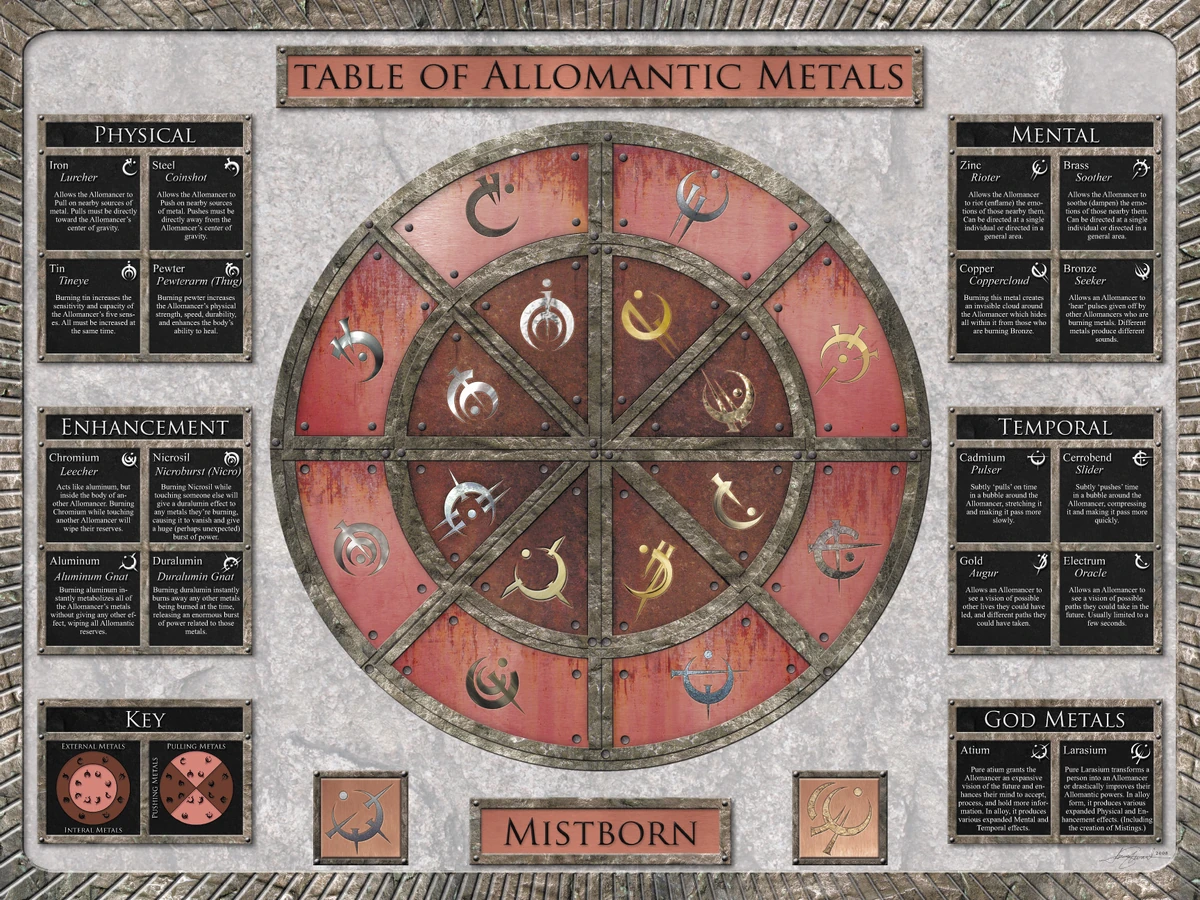
This is the list I found before, it is fun as in the different metals have different attributes given to the user.
What I was planning on however, is how each metal having different response to mana, a little bit like how metal react to heat or electricity. The reddit posts are not that helpful as in the final answer is just "go read it yourself", there has not been a finalised and clear answer to it. Pf course the mythical metal Mythril is a good conductor and some said it is just Silver, only more magical, thus going by that logic Silver is a good conductor as well. But what about Gold? Which metal is its proxy? Orichalcum? Adamantium?
Orichalcum was supposed to be some kind of alloy from Greece, and was a very strong metal. Adamantium is a fictional metal that actually came about rather recently historically speaking. It was invented by Marvel comics. It is something that didn't exist in any lore before they came up with it.
Going by this, neither metal would be analogous to gold. Historically speaking, there is a fairly high chance Orichalcum very well might have been the Greek word for the product of a certain form of steel smelting as it occasionally involves the inclusion of certain other metals to strengthen it. It may surprise most people, but steel existed before the medieval era. It's a metal that was lost and re-discovered several times throughout history. So, the lost Greek metal Orichalcum could very well be just another example of that. The Greeks also had Damascus steel, which is another metal absolutely positively identified as steel. So, they knew about steel but Orichalcum was supposed to be stronger. If Orichalcum is historical (which has a high probability of being the case,) then it suggests the Greeks had some form of bloomery smelting technology that there is not much surviving evidence of and they used it to smelt and mix certain inclusions like, maybe, tin into the steel.
As for uses in fiction, well... Marvel portrays Adamantium as being an alloy that is unbreakable, but never specifies what it's made from. Only that you have to mix it in a completely molten form, and then once it cools it is impossible to ever deform from the state it cooled into. Fantasy series that have later adopted the use of Adamantium, however, often portray it as a mono-metal. As in, it is dug up from the ground as Adamantium. It is portrayed with characteristics similar to lead in this form, except that it's also stronger than steel.
Marvel might have originally had some kind of traidmark on Adamantium, but it is evident that the Japanese were unaware of this traidmark and started using it so frequently in their fantasy fiction that it bled over back into the states and made an appearance in Dungeons and Dragons in the 2000s early enough to have been in 3rd edition. At this point, if any trade mark on Adamantium existed, it became public domain when they didn't enforce on Wizards of the Coast unless they got the permission to use the metal officially and I didn't know about it. Even if they did though, the slew of Japanese fictions and Japanese inspired fictions since then that use Adamantium have created a situation where the IP became uninforcable, and now it's DEFINITELY public domain as a result.
Those are the real world histories of each, you can derive some properties from that.