Writing How important are dialogue tags in your fiction?

Eldoria

Well-known member
Joined
Jun 14, 2025
Messages
1,565
Points
113
Using of Dialogue Tags in Fiction

In dialogue, tags are often used to briefly identify characters. Dialogue tags like "Barry said...", "...Annie said, patting Barry's shoulder," "...the blonde girl complained," etc, can provide quick navigation in identifying who is speaking while providing quick context.

However, on the other hand, conversations are more immersive if dialogue tags are minimized. The use of dialogue tags often suggests the narrator is directing the reader, which reduces immersion.

Furthermore, if each character has a unique voice, ideally the character can be recognized by the reader even without mentioning who is speaking using tags.

However, again, the platform also determines... in web novels, the use of dialogue tags is more practical, making it easier for new readers who read from any chapter to quickly understand the narrative.

This is different from traditional novels... where readers start reading from page 1, making character introduction and development relatively easy for readers to understand from the beginning. So, my questions are:
  1. How important are dialogue tags in your fiction?
  2. How do you use tags or not appropriately according to your narrative needs in dialogue?
 

Juia_Darkcrest

Well-known member
Joined
Jun 9, 2025
Messages
894
Points
93
I use " " John said/replied/whatever, sometimes adding some action as well.

If there are only two talking for more than a couple of exchanges, I will identify them both first, then allow their different speech patterns do the rest of the work for me.

I frequently will add actions at the end of a dialogue sentence to give more depth to the scene. ie;

"Really, John? Is that how it is going to be?" she replied, crossing her arms across her chest, an incredulous look forming on her face.

Or,

"Now, speak!" He growled, clenching his fist, struggling not to beat the living daylights out of this piece of trash. He didn't have time right now.

I also use Italics for a character's inner thoughts, usually only the MC or whoever is POV for the scene and do not identify them at all.

I can't believe they did this again! Are they trying to die?
 

Lmae

Member
Joined
Feb 12, 2026
Messages
31
Points
18
I try to minimize my use of dialogue tags by using stage direction and removing them if the conversation is between two people .
When I do use dialog tags I try to stick with said..
 

JordanIda

Active member
Joined
Jan 9, 2026
Messages
142
Points
43
The more necessary they are, the weaker the characters.

The reader should not need prompts. Each speaker should have a distinctive voice, which should be identifiable in terms of not only the prevailing situation, but also the variations in the characters' persona, style of discourse, and lexicon.

Readers can identify effective characters without prompts.
 

Rachel_Leia_Cole

Goblin politicist
Joined
Jan 11, 2026
Messages
110
Points
63
Thinking about this question, I realize I use them a lot, but usually paired with an expression (Adair questioned, his eyes narrowing.) Or with an action (Lord Greene stated, slamming his hand on the table). Of course I don’t do that with every tag. But rarely do I bust out with a plain (he said.) I’ll leave off a tag if I can if it comes to it. But my characters are not usually static when speaking, they are doing things, feeling things.
 
Last edited:

TinaMigarlo

the jury is back. I'm almost too hot for smuthub.
Joined
Jan 9, 2026
Messages
506
Points
93
someone helping me called mine "action identifiers" or something. I handle dialogue different from most.

example:
------------------------
"Yes."

"Just a suggestion. Where I come from, when we're very young. A parent, another responsible adult. They will sometimes, and I know how this sounds, but. Smack a little kid upside the head. To teach them not to be shameful."

Rida chuckled.

"Ah. Rest assured, Kerl-san. Where we came from, when times were normal. Yes, you would have seen such a thing. Yet now, these are strange times we live in. And, this is a very long conversation. One we will have, I assure you. But I offer you my hand, as I say this. In time, you will understand why things are as they are. This, I promise you."
------------------------

I avoid all the autistic nitpicking rules. comma inside the quotes, capitalize that. Dont czpitalize there, comma outside the quote. Period doesn't go there! Its maddening.

its clear, its direct. I avoid all the "A said, B said" repetition. I assign what "they called" action identifiers. I have a million of them, I don't let them get repetetive. At the sightest *whiff* of (before) its not clear who speaks next, I plop something in. Its distracting to me, to see those little prose (tags) between dialogue.

its like a screenplay, very clear. Its not totally incorrect, every dialogue gets its own paragraph. I use "what you call it" to indicate who is about to speak. I triled a lot of different things this was the easiest to do, as well as very easy to read (for me, anyways)

I get tired of all that "no! the period is outside the quotes!" whining.
 

c37

Active member
Joined
May 13, 2025
Messages
179
Points
43
I started associating dialogues with an action, like-- By now his master stood in front of the table with a glass bottle of blood ale in his hand, “Pardon me, sir, but I only had one bottle of—” his voice stopped mid-sentence as he noticed his slave sitting beside his patron.
 

Juia_Darkcrest

Well-known member
Joined
Jun 9, 2025
Messages
894
Points
93
someone helping me called mine "action identifiers" or something. I handle dialogue different from most.

example:
------------------------
"Yes."

"Just a suggestion. Where I come from, when we're very young. A parent, another responsible adult. They will sometimes, and I know how this sounds, but. Smack a little kid upside the head. To teach them not to be shameful."

Rida chuckled.

"Ah. Rest assured, Kerl-san. Where we came from, when times were normal. Yes, you would have seen such a thing. Yet now, these are strange times we live in. And, this is a very long conversation. One we will have, I assure you. But I offer you my hand, as I say this. In time, you will understand why things are as they are. This, I promise you."
------------------------

I avoid all the autistic nitpicking rules. comma inside the quotes, capitalize that. Dont czpitalize there, comma outside the quote. Period doesn't go there! Its maddening.

its clear, its direct. I avoid all the "A said, B said" repetition. I assign what "they called" action identifiers. I have a million of them, I don't let them get repetetive. At the sightest *whiff* of (before) its not clear who speaks next, I plop something in. Its distracting to me, to see those little prose (tags) between dialogue.

its like a screenplay, very clear. Its not totally incorrect, every dialogue gets its own paragraph. I use "what you call it" to indicate who is about to speak. I triled a lot of different things this was the easiest to do, as well as very easy to read (for me, anyways)

I get tired of all that "no! the period is outside the quotes!" whining.
so something like this would drive you nuts?


"Do you think this is a good idea? We won't have any idea what we will be facing until they are on top of us." Lucy asked. The pair of them stood outside their mechs near the cave where they fought the Jenner and Panther.

"It is either genius or insanity." He replied, holding her in his arms. "Just promise me you will back off if I tell you to this time. I have a couple more tricks up my sleeve, but I will have a hard time using them if I have to worry about you as well."

She leaned back on his chest, laughing softly. "You can heal the critically injured, cut the arms of a battlemech with a sword, and turn armour into metal blocks with little effort. Why am I not surprised my Danna has even more skills hidden away?"

"You know, you seem to be taking this incredibly well. Most other times I have brought this up, I have received a lot of disbelief, critical questions, and distrust. This world doesn't even have magic, yet you have accepted everything I have told you without any issue."

"Because I have faith, John-sama. You have the power to do things that only the Kami would be able to accomplish, and you used that power to save me and protect my family." She said, then looked up at him. "I have held onto my faith during these past three years, and you are my reward for not giving up and falling into despair. So even though we just met, I love you with all my heart, my Danna, and I will continue to do so for the rest of my days."

"Lucy. I am falling in love with you, too. I have no idea when we will have a chance, but I want to officially make you my wife, my Tsuna. I want to adopt Rei and grow our family. Together." He replied, then kissed her.

They held each other tightly while standing on that windy cliff face, talking about their past, planning for the future, all while waiting for the inevitable hammer to drop.
 

rainchip

Active member
Joined
Sep 2, 2025
Messages
73
Points
33
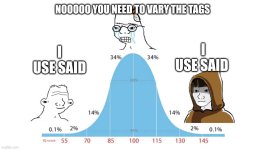
I try to keep it simple, I use said, unless they really did shout or yell or something. It's better to bridge the dialogue with an action or observation or something or even just let it be. I used to agonizing over dialogue tags ngl. This post inspired me to make this meme.
 

Attachments

  • aledhr.jpg
    aledhr.jpg
    59 KB · Views: 21

xizl

Member
Joined
Aug 24, 2025
Messages
31
Points
18
Usually, I try to set the format of the story up in a way that it's obvious who's speaking without. When I do that, I forego tags entirely and set the mood of the dialogue through prior scene description and character action. In the instance that there are multiple characters and it would be confusing, I use dialogue tags every 3 line exchanges, unless I'm switching the character speaking or expressing a specific mood or action to modify the line. I don't avoid adverbs entirely, as I think they can help change specific tone, but I try to reduce them to as little needed as possible. They often read strange if used too much or in too frequent bursts.

Describing actions has an implied slow-down in pace. Taking time to describe what's happening between lines is a good way to pace out slow scenes. I try to use no dialogue tags for snappy, quick paced dialogue, especially between two characters
 

Envylope

Queen of the Enpire
Joined
Oct 7, 2025
Messages
586
Points
93
I like dialogue tags, and I use them in tandem with action beats. I made a thread to show how I use them before. It is very simplified, so anyone can understand.


xizl

Member
Joined
Aug 24, 2025
Messages
31
Points
18
From 'Elements of Style, Fourth Edition':

“ Dialogue is a total loss unless you indicate who the speaker is. In long dialogue passages containing no attributives, the reader may become lost and be compelled to go back and reread in order to puzzle the thing out. Obscurity is an imposition on the reader, to say nothing of its damage to the work.

In dialogue, make sure that your attributives do not awkwardly interrupt a spoken sentence. Place them where the break would come naturally in speech — that is, where the speaker would pause for emphasis, or take a breath. The best test for locating an attributive is to speak the sentence aloud.

“Now, my boy, we shall see,” he said, “how well you have learned your lesson.” »»»»» “Now, my boy,” he said, “we shall see how well you have learned your lesson.”

“What’s more, they would never,” she added, “consent to the plan.” »»»»» “What’s more,” she added, “they would never consent to the plan.”
 

Envylope

Queen of the Enpire
Joined
Oct 7, 2025
Messages
586
Points
93
From 'Elements of Style, Fourth Edition':

“ Dialogue is a total loss unless you indicate who the speaker is. In long dialogue passages containing no attributives, the reader may become lost and be compelled to go back and reread in order to puzzle the thing out. Obscurity is an imposition on the reader, to say nothing of its damage to the work.

In dialogue, make sure that your attributives do not awkwardly interrupt a spoken sentence. Place them where the break would come naturally in speech — that is, where the speaker would pause for emphasis, or take a breath. The best test for locating an attributive is to speak the sentence aloud.

“Now, my boy, we shall see,” he said, “how well you have learned your lesson.” »»»»» “Now, my boy,” he said, “we shall see how well you have learned your lesson.”

“What’s more, they would never,” she added, “consent to the plan.” »»»»» “What’s more,” she added, “they would never consent to the plan.”
I like this example from a YouTube video I watched about a bad magician who is speaking to an audience.

"For my next trick," the magician said, "I will blow up this entire venue."

The magician said here is a good pause, and I appreciate things like this when done well.
I like this example from a YouTube video I watched about a bad magician who is speaking to an audience.

"For my next trick," the magician said, "I will blow up this entire venue."

The magician said here is a good pause, and I appreciate things like this when done well.
Actually, this was the full example from that video:

 
Last edited:

JayDirex

Well-known member
Joined
Jan 5, 2019
Messages
632
Points
133
The more necessary they are, the weaker the characters.

The reader should not need prompts. Each speaker should have a distinctive voice, which should be identifiable in terms of not only the prevailing situation, but also the variations in the characters' persona, style of discourse, and lexicon.

Readers can identify effective characters without prompts.
The reader is also human, and a wall of text can be blinding. Hence a sprinkle of the name of the character maybe doing something, or an occasional, "Jane said" in a wall of dialog.

Just an anchor so the reader could see a name even if they look away.
 

xizl

Member
Joined
Aug 24, 2025
Messages
31
Points
18
Thinking about this question, I realize I use them a lot, but usually paired with an expression (Adair questioned, his eyes narrowing.) Or with an action (Lord Greene stated, slamming his hand on the table). Of course I don’t do that with every tag. But rarely do I bust out with a plain (he said.) I’ll leave off a tag if I can if it comes to it. But my characters are not usually static when speaking, they are doing things, feeling things.
I actually recommend often using said over any alternatives, unless it's expressing an emotion or action important to the scene.

I use said as a dialogue tag like 70% of the time if I'm adding them.

"Said" is an invisible word. Many of your readers skim over the tag anyways. Using something else draws attention to the word, which is why things can sound clunky in an otherwise well-written sentence.
 

Eldoria

Well-known member
Joined
Jun 14, 2025
Messages
1,565
Points
113
The reader is also human, and a wall of text can be blinding. Hence a sprinkle of the name of the character maybe doing something, or an occasional, "Jane said" in a wall of dialog.

Just an anchor so the reader could see a name even if they look away.
I mentioned earlier in this thread the use of dialogue tags as a practical tool for character navigation in web novel chapters. We can't expect new readers to start reading from chapter 1 (even though I hope so).

Without adequate character identity clues, dialogue tags, new readers will have a hard time to recognize who is speaking.

Authors may have written a well-crafted narrative with each character having a unique voice, but sometimes authors forget... readers don't always recognize your characters; they won't bother reading dozens of chapters just to remember "character voices."

Therefore, dialogue tags, while considered noise, have greater practical value in facilitating narrative comprehension within the web novel ecosystem.
 
Last edited:

MFontana

Well-known member
Joined
Oct 24, 2025
Messages
374
Points
93
Using of Dialogue Tags in Fiction

In dialogue, tags are often used to briefly identify characters. Dialogue tags like "Barry said...", "...Annie said, patting Barry's shoulder," "...the blonde girl complained," etc, can provide quick navigation in identifying who is speaking while providing quick context.

However, on the other hand, conversations are more immersive if dialogue tags are minimized. The use of dialogue tags often suggests the narrator is directing the reader, which reduces immersion.

Furthermore, if each character has a unique voice, ideally the character can be recognized by the reader even without mentioning who is speaking using tags.

However, again, the platform also determines... in web novels, the use of dialogue tags is more practical, making it easier for new readers who read from any chapter to quickly understand the narrative.

This is different from traditional novels... where readers start reading from page 1, making character introduction and development relatively easy for readers to understand from the beginning. So, my questions are:
  1. How important are dialogue tags in your fiction?
  2. How do you use tags or not appropriately according to your narrative needs in dialogue?
1) They're very important, especially when you have multiple characters engaged in the conversation, and engaged in action simultaneously.
2) As for how I use them... well, I'll try to vary them up with dialogue-verbs, paired with whatever action the character is taking at the time, or will layer the dialogue within the scene as needed by the narrative.
If it is, or should be, immediately obvious who is speaking, I may omit tagging it with a name, and will simply opt for the relevant pronoun for the action conveyed while the speech is occurring.

There's actually a lot of dialogue in Aestelle Nocte, Chapter 3, especially near the end of the chapter, so I might as well drop a little sample straight from the soon-to-be-released chapter as an example of what I mean, for my own stories anyway.

"Did you grab anything for yourselves, or is this all for Jaeyla?" Tobias asked Isabel while Dani was engaging the cashier, Stacey according to her name badge, with her usual casual banter.

"It's all for her. Dani just grabbed the jackets for us."

With a nod, he took the jacket from the cart and handed it to the cashier.

"There's three of them." He said, while signaling to Stacey he meant the jacket, and just offered Dani a knowing smirk when her jaw nearly hit the counter.

"You know... they're like two hundred each... right?"

"It's just a jacket." He answered casually, as if the price wasn't even a factor. "If that's all it costs me for your help today, then I'm getting off easy."
 
Top