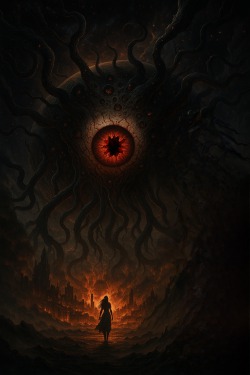
Try reading my chapter (not the first chapter), which can be considered a standalone. This chapter is about cosmic horror in a gothic fantasy world. However, I might disappoint you... this feedback thread is closed-ended. If you're interested, please read the following thread. The chapter is already in the thread.
Regards.
Feedback to Measure the Reader's Perception of Character Identifier Could you help me gauge how readers perceive multiple characters in a chapter? I'd like to know how causal readers identify characters in a narrative. If you'd like, please follow these instructions: 1. Read only the chapter...

forum.scribblehub.com
Done!
This sounds like exactly what you're looking for! Finally! Let me know what you think.
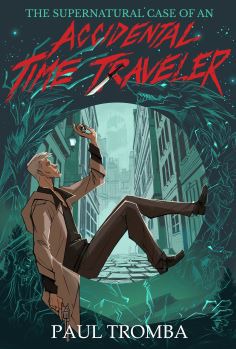
Ever consider going back in time? Is it on purpose and to a specific time? Well, not this time in The Supernatural Case of an Accidental Time Traveler. This story is the first in a series of time-travel escapades with various supernatural and mythological undertones scattered throughout the...

www.scribblehub.com
The being's tandem tone of devilish intrigue and a satirical simper made form in its expression of a sadistic humanoid smirk where the voice had previously bemoaned.
This is quite a sentence. If you read it out loud, it should be clear that it's not very easy to read. I feel like the whole prologue could do with being read out loud, as there are many sentences I had to read over a few times before I understood what they meant.
There was a dream. To say it felt more like a nightmare would not be an exaggeration.
This doesn't sound like something a person coming out of a nightmare would say.
Gazing back over my shoulder, the forest began folding outward to reveal the night sky, filled with more stars than the mind can comprehend.
This sentence sums up my main beef with the prologue, which is that it feels Large Scale without any Emotional Truth to ground it. If you're saying that a human mind can't comprehend something, then that has implications and gravitas - it's not something that you just brush off. "Filled with more stars than the mind can comprehend" sounds cool but if you consider what that means in a real, what-if-I-was-experiencing-this kind of way, then it's horrifying and overwhelming. It's not something to mention in passing and then move on.
My attention drawn up to follow it, I stumble back in bafflement from the sudden replacement for the child being myself, standing in aloof confusion by the sight of me.
Tense switch
“You will find the answer when you succeed,” he replied as if he’d said it a thousand times before and were tired of it before falling through the water floor.
There are moments like this where I feel the writing would be stronger if you showed the moment rather than described it. As in, what is it about the other's speech/facial expressions/body language that implies he's said this a thousand times before? An eye roll? An irritated tone? Folded arms? This kind of juxtaposition -- the cosmic impact of meeting your double in a nether zone vs that double being annoyed like this is all kinda mundane for them -- can work really well to add humour or a feeling of absurdity or lightness or verisimilitude that stops Cosmic Big Picture scenes from falling into pomposity.
A mix of the salty moist smell of the English Channel, baked goods, and mild garbage wafted in the air.
The English Channel is the stretch of ocean between England and France, which is not near London. There's the Thames, which is the river that runs through London, but it isn't salty, and it wouldn't be smelled in Whitechapel. Is your narrator English or American? In England we would say "rubbish" not "garbage" or be more specific and talk about the bins overflowing nearby, or the smell of sewage coming up from the drains.
Cutting through Whitechapel on my way to work, as usual, I ducked through an alleyway.
"Cutting through" suggests a small area, as in cutting through a garden or down a street, but Whitechapel is a ward with a population of almost 15 thousand.
What threw me off the most was that the people that were still there were now dressed like it was the late Victorian era.
Be specific - this is a really cool opportunity to set the scene. I would also embellish more on how the narrator recognises the clothing as specifically late Victorian, because a casual observer wouldn't glance at an outfit and identify it as specific to a certain decade.
My clothes were just a black collared shirt and black dress pants.
If your narrator is English, he should be wearing trousers, not pants. A more common English term would be "smart trousers" or "suit trousers". Also, it's not clear if this narrator is the same narrator as the prologue, so it might be helpful to find a way to slip his name in here so we know who's who.
The more sights I took in, the more I felt like I was part of some movie set.
If he's English, he would say "film set" not "movie set"
“You’re in Whitechapel, London kid. You probably didn’t realize it because this is the only part of Whitechapel that isn’t littered with whores and beggars,” he replied with a click of his tongue.
"Kid" is modern American. "Kiddie" was sometimes used, but as a term of endearment, like a father to his children. It also feels a bit too convenient that he specifies Whitechapel, London.
“Just get out of here,” he glowered at me.
Why is he so unfriendly? Doesn't he want to make a sale?
At the corner, I saw a young boy dressed in the same late Victorian-style clothing that everyone seemed to be wearing.
Again, this is a great opportunity to be specific - especially as a small boy selling papers is going to be wearing slightly different clothes to a street seller, who'd be wearing slightly different clothes to any middle class people passing by.
Damn it, now I look even edgier than before.
How does he know? It's not like there's a mirror nearby.
Wait, that vendor said there were tons of them here, so I don’t think this is a charitable area.
Tense switch
I looked even edgier. Was this timeline trying to make me an edgelord or something? My face was still clean-shaven, and I still had a mole under the right side of my chin. The pupils I had were severely dilated, and my eye colour had changed from brown to grey, with a yellow ring around the pupil.
I get the impression you have a strong visual for your character, which is cool, but it's a bit annoying to go on like this about how edgy he looks. Just describe him, and allow us to think "wow I bet he looks edgy". Also I don't know if a glass window would be reflective enough to see details like this about someone's eye colour.
There were more dirt and cobblestone streets than before, and it wasn’t very bright out due to a low-hanging smog-like fog that reeked of coal, tobacco, and hot iron, along with a far more distinct sulfuric smell from the English channel.
The Thames, not the English channel. If the year is 1888, London had had its sewage system for thirty years by now, so the Thames is well past its most stinky era.
Not only that, but they reeked of alcohol, fish guts, and tar.
How does he know what fish guts specifically smell like? And tar?
His buddy, still drunk as could be, stepped behind me to block my exit.
If your narrator is English, "mate" would be better than "buddy".
Sitting at the end of the alleyway was an old man dressed in a business suit with his tie loosened and some bread in his hand.
What does a business suit look like? Is he wearing a Victorian suit? A modern one? If it's a Victorian one, how can the narrator differentiate it from an everyday suit?
“Because that was the most entertaining fight I have ever seen in this alley, and there are quite a few of them, innit,” he said between his giggles.
"Innit" is too modern.
“I am Harold Lewak. Now, come and sit. If I got my ass kicked like that then I would be hungry. The bread will calm your nerves.” he said, gesturing at his loaf of bread beside him.
He'd say "arse" not "ass".
“If I may ask, why are you in this alley, where so many angry drunks frequent?” I asked him in an attempt at sounding like I was from this era, or as a butler from a British drama because that's the only reference I had.
So the narrator is American? An English person would say "English" not "British" but they'd probably say something like "an old BBC drama" or outright say "Downton Abbey".
“To be frank, I’m getting up there in age. Thus, I've been laid off and have no desire to tell the missus yet. So I sit here, watching the drunks and pickpockets pass by, waiting for something interesting to happen. A real shame, innit.” he said with a deep and solemn sigh.
Comma to end the dialogue, not a full stop. Again, I'd query the use of "innit" and also "laid off".
A resource I'd really recommend for getting a better feel for Victorian London is Henry Mayhew's London Labour and the London Poor. Mayhew was a journalist who went around and interviewed the street sellers and general populace of London in the 1860s. It's a few decades before your setting, but it'll give a flavour for how people spoke and how they approached their circumstances. "How To Be A Victorian" by Ruth Goodman is another great resource.