
Climate change and overpopulation

  • Thread starter Deleted member 76176
  • Start date
Status
Not open for further replies.

AnonUnlimited

????????? (???/???)
Joined
Apr 18, 2022
Messages
4,573
Points
183
I think they can get ice cores from the antarctic. I don't know how accurate that can be. Measurements in the parts per million in gas is hard, not sure how they do it in ice.
Well, I find every article that talks about measurements conveniently forgets to explain the methodology behind it, or the methodology of how they measured before 1900's is kind of whack. Same can be said of people who say the Earth was much hotter in Europe during the Middle Ages... we didn't have any temperature reading devices for the past... also we don't know if taking temperatures/climates and other things are even accurate.

Not to mention, Co2 can concentrate in one part of the world more than the other. They're usually higher at night... I just find it funny that people are always quoting these measurements with absolute certainty. Look, If I were able to repeat the experiments with my own equipment then maybe I'd believe them.

But... I don' have the means to operate a CO2 censor everywhere around the Earth at the same time to measure atmospheric CO2, nor do I have the ability to keep track of all 27,000 volcanos in the sea to see if that's why the Co2 in the ocean is actually rising. Couple that with a clear agenda on both sides... you can see why I'm very skeptical on everything, especially when politicians are trying to make policies that benefit their stock holdings.
 
D

Deleted member 76176

Guest
Well, I find every article that talks about measurements conveniently forgets to explain the methodology behind it, or the methodology of how they measured before 1900's is kind of whack. Same can be said of people who say the Earth was much hotter in Europe during the Middle Ages... we didn't have any temperature reading devices for the past... also we don't know if taking temperatures/climates and other things are even accurate.

Not to mention, Co2 can concentrate in one part of the world more than the other. They're usually higher at night... I just find it funny that people are always quoting these measurements with absolute certainty. Look, If I were able to repeat the experiments with my own equipment then maybe I'd believe them.

But... I don' have the means to operate a CO2 censor everywhere around the Earth at the same time to measure atmospheric CO2, nor do I have the ability to keep track of all 27,000 volcanos in the sea to see if that's why the Co2 in the ocean is actually rising. Couple that with a clear agenda on both sides... you can see why I'm very skeptical on everything, especially when politicians are trying to make policies that benefit their stock holdings.

I don’t think I’m qualified to answer this, but scientists study ice cores to know how the climate and temperature were in the past, among other things. By looking at past concentrations of greenhouse gases in ice cores, scientists can calculate how modern amounts of carbon dioxide and methane compare to those of the past and compare past concentrations of greenhouse gases to temperature. There should be videos and articles on the internet about this topic. Science is a wonderful thing.
 

AnonUnlimited

????????? (???/???)
Joined
Apr 18, 2022
Messages
4,573
Points
183
I don’t think I’m qualified to answer this, but scientists study ice cores to know how the climate and temperature were in the past, among other things. By looking at past concentrations of greenhouse gases in ice cores, scientists can calculate how modern amounts of carbon dioxide and methane compare to those of the past and compare past concentrations of greenhouse gases to temperature. There should be videos and articles on the internet about this topic. Science is a wonderful thing.
I've seen those videos, and read articles on it. The problem is it's a 'calculation' which means as long as they take the variables and enter it into a predictable formula, it will always come out in a way that is formulaic and won't account for other variables, when there is no repeatable testing done. Not to mention, today... I can easily make carbonated water, freeze it and then say "oh hey look at how much carbon is in something."

Either case, the amount of carbon dioxide, methane or lack thereof in frozen ice could have other explanations besides "it was the atmosphere."

Proof requires repeatable testing, everything else is purely theory which may or may not be accurate.

Yes, Science is a wonderful thing when it's unbiased and skeptical.


Just wanted to add this article. It goes into how they measure layers, but there is no specifics as to how they "know" which layer is from which time period, yet they're somehow able to come to the conclusion Co2 started rising in the 19th century. I don't get how they can easily come to that conclusion, claim it's true without explaining any methodology as to how they can accurately determine which layer is from which time period.

Sorry. The whole subject to me is interesting.
 
Last edited:

AnonUnlimited

????????? (???/???)
Joined
Apr 18, 2022
Messages
4,573
Points
183
Wow, this is still ongoing. Enteresting...Enteresting Endeed.
The biggest problem with climate change is that it's pretty much a political topic where everyone has an agenda. So it's hard to find out what's really going on. Anyway, it doesn't matter.

I probably won't have any descendants so I shouldn't care about what happens after I die.
 
D

Deleted member 76176

Guest
I've seen those videos, and read articles on it. The problem is it's a 'calculation' which means as long as they take the variables and enter it into a predictable formula, it will always come out in a way that is formulaic and won't account for other variables, when there is no repeatable testing done. Not to mention, today... I can easily make carbonated water, freeze it and then say "oh hey look at how much carbon is in something."

Either case, the amount of carbon dioxide, methane or lack thereof in frozen ice could have other explanations besides "it was the atmosphere."

Proof requires repeatable testing, everything else is purely theory which may or may not be accurate.

Yes, Science is a wonderful thing when it's unbiased and skeptical.

I'll be going a bit serious here. No hard feelings.

1. Ice core data is one of many pieces of evidence that support the notion of climate change and its impact on our planet. NASA has compiled a great deal of evidence, ranging from temperature monitoring to the migration of butterflies, tree-ring analysis, sediment and rock layers, coral reefs, etc., that supports the notion of climate change. Ice core data, then, is simply another piece in an increasingly overwhelming body of research.

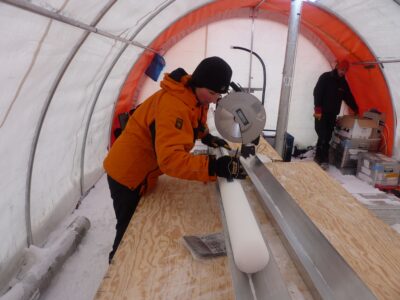
2. Ice core data is not just a "calculation" that scientists cook up. The process of extracting ice cores is meticulous and incredibly time-consuming. The equipment used to extract them is incredibly precise, and each sample is examined under various measures – including chemical analysis - before reaching its conclusion. The resulting information is then cross-referenced with other studies performed to support a holistic view of historical atmospheric changes.

3. Even if there were discrepancies in the number of parts per million in ice cores, the amounts that scientists have been measuring in the ice cores are over and above these levels, and while it is true that it's possible to increase carbon dioxide levels in the ice by subjecting it to certain conditions in a lab, the trend they indicate is of increasing greenhouse gas emissions.

4. Ice core data is a time-tested and peer-reviewed source of information that lends tremendous support to the scientific consensus around climate change, and I trust scientists are not stupid. While there may be discrepancies in any one data source, the magnitude of supporting evidence surrounding climate change cannot be ignored in any discussion about the state of our planet.
 

AnonUnlimited

????????? (???/???)
Joined
Apr 18, 2022
Messages
4,573
Points
183
I'll be going a bit serious here. No hard feelings.

1. Ice core data is one of many pieces of evidence that support the notion of climate change and its impact on our planet. NASA has compiled a great deal of evidence, ranging from temperature monitoring to the migration of butterflies, tree-ring analysis, sediment and rock layers, coral reefs, etc., that supports the notion of climate change. Ice core data, then, is simply another piece in an increasingly overwhelming body of research.

2. Ice core data is not just a "calculation" that scientists cook up. The process of extracting ice cores is meticulous and incredibly time-consuming. The equipment used to extract them is incredibly precise, and each sample is examined under various measures – including chemical analysis - before reaching its conclusion. The resulting information is then cross-referenced with other studies performed to support a holistic view of historical atmospheric changes.

3. Even if there were discrepancies in the number of parts per million in ice cores, the amounts that scientists have been measuring in the ice cores are over and above these levels, and while it is true that it's possible to increase carbon dioxide levels in the ice by subjecting it to certain conditions in a lab, the trend they indicate is of increasing greenhouse gas emissions.

4. Ice core data is a time-tested and peer-reviewed source of information that lends tremendous support to the scientific consensus around climate change, and I trust scientists are not stupid. While there may be discrepancies in any one data source, the magnitude of supporting evidence surrounding climate change cannot be ignored in any discussion about the state of our planet.
I don't think you understand. I'll try to be precise with this.

I'm not questioning the data. I'm questioning the conclusion.
Their methodology doesn't allow for their conclusion.
 

Midnight-Phantom

( Enigmatic-Entity )
Joined
Feb 27, 2023
Messages
323
Points
78
You guys are still debating on this subject! I'm dizzy. :blob_dizzy: :sweating_profusely:

If someone reads the whole thread from beginning to end, they will come to one conclusion: people nag too much. A lot of people have pointed out a lot of different viewpoints, and I have noticed that a lot of people are quick to blame CO2. But what has CO2 done to deserve it? There are a whole lot of elements responsible for climate change, or should I say, the delicate balance between all the elements and their behaviour with said or introduced variables are responsible for the produced result. No data to date has concluded on this subject, and it will change as time goes on and new variables are introduced.

We need to plant trees. They will handle a whole lot of problems. We also need to improve our infrastructure on waste management issues. A lot of types of plants, mostly underwater ones, have been left unsaid in this thread. We also need to discuss our energy production infrastructure. Then, farming, food, or in general, agriculture-related things, need to be pointed out too.

A whole lot of things need to be pointed out to even stress the importance of climate change. It's not just about scientific research on gasses.
 
Last edited:

AnonUnlimited

????????? (???/???)
Joined
Apr 18, 2022
Messages
4,573
Points
183
You guys are still debating on this subject! I'm dizzy. :blob_dizzy: :sweating_profusely:

If someone reads the whole thread from beginning to end, they will come to one conclusion: people nag too much. A lot of people have pointed out a lot of different viewpoints, and I have noticed that a lot of people are quick to blame CO2. But what has CO2 done to deserve it? There are a whole lot of elements responsible for climate change, or should I say, the delicate balance between all the elements and their behaviour with said or introduced variables are responsible for the produced result. No data to date has concluded on this subject, and it will change as time goes on and new variables are introduced.

We need to plant trees. They will handle a whole lot of problems. We also need to improve our infrastructure on waste management issues. A lot of types of plants, mostly underwater ones, have been left unsaid in this thread. We also need to discuss our energy production infrastructure. Then, farming, food, or in general, agriculture-related things, need to be pointed out too.

A whole lot of things need to be pointed out to even stress the importance of climate change. It's not just about scientific research on gasses.
I agree with this.
 
D

Deleted member 76176

Guest

Just wanted to add this article. It goes into how they measure layers, but there is no specifics as to how they "know" which layer is from which time period, yet they're somehow able to come to the conclusion Co2 started rising in the 19th century. I don't get how they can easily come to that conclusion, claim it's true without explaining any methodology as to how they can accurately determine which layer is from which time period.

Sorry. The whole subject to me is interesting.

I don't think you understand. I'll try to be precise with this.

I'm not questioning the data. I'm questioning the conclusion.
Their methodology doesn't allow for their conclusion.
There are several methods scientists use to date ice cores.
1. Visual-stratigraphic dating

The way they do it is by counting the visible annual layer of the Ice core, similar to counting the rings of a tree to determine its age. This is also perhaps the least accurate method, so here's a paper on its accuracy.

Visual‐stratigraphic dating of the GISP2 ice core: Basis, reproducibility, and application - Alley - 1997 - Journal of Geophysical Research: Oceans - Wiley Online Library

2. Forward and inverse modelling

They are two complementary approaches for studying ice cores, which use mathematical models to determine the age of ice cores at specific depths. Forward modelling involves running a simulation given a set of input parameters. Inverse modelling involves inferring the parameters of these processes from the observed isotopic records in ice cores. Combined with these two, scientists can accurately predict how deep they had to dig to find ice cores, and it works.

3. Radiometric dating

By measuring the concentration of certain isotopes in the ice, such as 39Ar, 85Kr, 10Be or 238U, scientists can estimate how old the ice is and construct a chronology of past events. Here's another paper on the accuracy of radiometric dating using carbon 14.

Towards radiocarbon dating of ice cores | Journal of Glaciology | Cambridge Core

Of course, there are several challenges when it comes to it. That's why scientists use multiple methods and cross-check their results with other methods, including the ones I mentioned here, volcanic ash, geochemistry, electrical conductivity, etc. When everything points at the same timescale, we can reasonably say we got it right.

I realised that sooner or later this is going to go in religion's direction, so let's agree to disagree. Neither I'm qualified nor vested enough to have this discussion. The nervous energy of the upcoming surgery must have rubbed me the wrong way for me to type this. Have a good day!
 

AnonUnlimited

????????? (???/???)
Joined
Apr 18, 2022
Messages
4,573
Points
183
There are several methods scientists use to date ice cores.
1. Visual-stratigraphic dating

The way they do it is by counting the visible annual layer of the Ice core, similar to counting the rings of a tree to determine its age. This is also perhaps the least accurate method, so here's a paper on its accuracy.

Visual‐stratigraphic dating of the GISP2 ice core: Basis, reproducibility, and application - Alley - 1997 - Journal of Geophysical Research: Oceans - Wiley Online Library

2. Forward and inverse modelling

They are two complementary approaches for studying ice cores, which use mathematical models to determine the age of ice cores at specific depths. Forward modelling involves running a simulation given a set of input parameters. Inverse modelling involves inferring the parameters of these processes from the observed isotopic records in ice cores. Combined with these two, scientists can accurately predict how deep they had to dig to find ice cores, and it works.

3. Radiometric dating

By measuring the concentration of certain isotopes in the ice, such as 39Ar, 85Kr, 10Be or 238U, scientists can estimate how old the ice is and construct a chronology of past events. Here's another paper on the accuracy of radiometric dating using carbon 14.

Towards radiocarbon dating of ice cores | Journal of Glaciology | Cambridge Core

Of course, there are several challenges when it comes to it. That's why scientists use multiple methods and cross-check their results with other methods, including the ones I mentioned here, volcanic ash, geochemistry, electrical conductivity, etc. When everything points at the same timescale, we can reasonably say we got it right.

I realised that sooner or later this is going to go in religion's direction, so let's agree to disagree. Neither I'm qualified nor vested enough to have this discussion. The nervous energy of the upcoming surgery must have rubbed me the wrong way for me to type this. Have a good day!
Again I don't think you understand. All those methods are interpretation of data and estimations.
Data is just that... data.
The process for acquiring that data is methodology, and in order to arrive at the conclusion they have, the methodology isn't sufficient.

You mention "radio carbon dating," and I think you need to read up on how atomic bombs and nuclear bombs affect the air and 'carbon dating' itself. There are many variables left out when they make conclusions on available data.

Simulations are not actual. There is still a debate in America, though largely suppressed by the government about whether "jet fuel melts steel beams." All arguments however are inconclusive unless we can build a giant tower and ram an airplane into it again to see if it actually happens, but those who disagree are quickly discredited (often dubiously) and shut out by almost all government funded science institutions here, and media won't talk about it. I've had it happen to a few friends I know.

I can agree that there is some man-made climate change going on, but again, my whole contention here is if anyone wants to make legislative policy then they better prove it definitively instead of relying on simulation models and data and scientist control.

We can disagree on whether we have faith in the current science or not, but I don't think we can go further in this discussion.
 
D

Deleted member 113259

Guest
How in the world is that a debate? :blob_frown: :blob_cookie:
Technically both sides are objectively correct.
For the 9/11 was a conspiracy side it's objectively true that jet fuel can't melt steel beams. It's not hot enough.
For the 9/11 was terrorists side jet fuel can however greatly soften the steal beams enough to collapse the building.
 

Aaqil

Cookies!
Joined
Jan 4, 2021
Messages
1,217
Points
153
Technically both sides are objectively correct.
For the 9/11 was a conspiracy side it's objectively true that jet fuel can't melt steel beams. It's not hot enough.
For the 9/11 was terrorists side jet fuel can however greatly soften the steal beams enough to collapse the building.
Ah, ti's the plane and tower thing, :blob_cookie:
Carry on, ignore me message, :blob_cookie:
 
D

Deleted member 76176

Guest
Again I don't think you understand. All those methods are interpretation of data and estimations.
Data is just that... data.
The process for acquiring that data is methodology, and in order to arrive at the conclusion they have, the methodology isn't sufficient.

Papers? Then I also pointed out they cross reference to increase the accuracy.

You mention "radio carbon dating," and I think you need to read up on how atomic bombs and nuclear bombs affect the air and 'carbon dating' itself. There are many variables left out when they make conclusions on available data.

Papers? Interesting, considering atomic bombs made it possible to carbon date.

Simulations are not actual. There is still a debate in America, though largely suppressed by the government about whether "jet fuel melts steel beams." All arguments however are inconclusive unless we can build a giant tower and ram an airplane into it again to see if it actually happens, but those who disagree are quickly discredited (often dubiously) and shut out by almost all government funded science institutions here, and media won't talk about it. I've had it happen to a few friends I know.
And why it works when it concerns climatology then?

I won't be replying after this.
 

Prince_Azmiran_Myrian

🐉Religious zealot exhorting Dragons for Jesus🐉
Joined
Aug 23, 2022
Messages
2,833
Points
153
Again I don't think you understand. All those methods are interpretation of data and estimations.
Data is just that... data.
The process for acquiring that data is methodology, and in order to arrive at the conclusion they have, the methodology isn't sufficient.

You mention "radio carbon dating," and I think you need to read up on how atomic bombs and nuclear bombs affect the air and 'carbon dating' itself. There are many variables left out when they make conclusions on available data.

Simulations are not actual. There is still a debate in America, though largely suppressed by the government about whether "jet fuel melts steel beams." All arguments however are inconclusive unless we can build a giant tower and ram an airplane into it again to see if it actually happens, but those who disagree are quickly discredited (often dubiously) and shut out by almost all government funded science institutions here, and media won't talk about it. I've had it happen to a few friends I know.

I can agree that there is some man-made climate change going on, but again, my whole contention here is if anyone wants to make legislative policy then they better prove it definitively instead of relying on simulation models and data and scientist control.

We can disagree on whether we have faith in the current science or not, but I don't think we can go further in this discussion.
There are several methods scientists use to date ice cores.
1. Visual-stratigraphic dating

The way they do it is by counting the visible annual layer of the Ice core, similar to counting the rings of a tree to determine its age. This is also perhaps the least accurate method, so here's a paper on its accuracy.

Visual‐stratigraphic dating of the GISP2 ice core: Basis, reproducibility, and application - Alley - 1997 - Journal of Geophysical Research: Oceans - Wiley Online Library

2. Forward and inverse modelling

They are two complementary approaches for studying ice cores, which use mathematical models to determine the age of ice cores at specific depths. Forward modelling involves running a simulation given a set of input parameters. Inverse modelling involves inferring the parameters of these processes from the observed isotopic records in ice cores. Combined with these two, scientists can accurately predict how deep they had to dig to find ice cores, and it works.

3. Radiometric dating

By measuring the concentration of certain isotopes in the ice, such as 39Ar, 85Kr, 10Be or 238U, scientists can estimate how old the ice is and construct a chronology of past events. Here's another paper on the accuracy of radiometric dating using carbon 14.

Towards radiocarbon dating of ice cores | Journal of Glaciology | Cambridge Core

Of course, there are several challenges when it comes to it. That's why scientists use multiple methods and cross-check their results with other methods, including the ones I mentioned here, volcanic ash, geochemistry, electrical conductivity, etc. When everything points at the same timescale, we can reasonably say we got it right.

I realised that sooner or later this is going to go in religion's direction, so let's agree to disagree. Neither I'm qualified nor vested enough to have this discussion. The nervous energy of the upcoming surgery must have rubbed me the wrong way for me to type this. Have a good day!
I like how both of you say you aren't super invested yet continue to post.

And yes, the core of the debate is religious belief. Atheists will interpret evidence in such a way to try and invalidate the bible. This is true in every field of science.

However, I think that Chirstian scientists that take biblical record into account are more accurate than the athiest narrative that is founded on deception. (Evolution, age of the Earth)

Ultimately, the ones who control scientific institutions are the ones who decide what science is acceptable. Science has been and still is more political than one would hope.

Side note: "peer reviewed" is an almost meaningless claim of legitimacy. There need only be a group of scientists believing the same thing. Junk science is more prevalent than you think.
 
Last edited:

AnonUnlimited

????????? (???/???)
Joined
Apr 18, 2022
Messages
4,573
Points
183
Papers? Then I also pointed out they cross reference to increase the accuracy.


Papers? Interesting, considering atomic bombs made it possible to carbon date.


And why it works when it concerns climatology then?

I won't be replying after this.
You probably shouldn’t ask questions in a response if you’re not going to reply.

Anyway.

1. It’s easy, to make and fudge cross references if one owns/controls all the data within a global community.

2. Atomic bombs made carbon dating possible. You see zero problem with this?

3. “Simulations” have said the world would be flooded in 2015. So there have been many widespread simulations that have failed in climatology already, what makes the next one more believable that we should give legislation power away?


I like how both of you say you aren't super invested yet continue to post.

And yes, the core of the debate is religious belief. Atheists will interpret evidence in such a way to try and invalidate the bible. This is true in every field of science.

However, I think that Chirstian scientists that take biblical record into account are more accurate than the athiest narrative that is founded on deception. (Evolution, age of the Earth)

Ultimately, the ones who control scientific institutions are the ones who decide what science is acceptable. Science has been and still is more political than one would hope.

Side note: "peer reviewed" is an almost meaningless claim of legitimacy. There need only be a group of scientists believing the same thing. Junk science is more prevalent than you think.
Agree that “peer review” is not a good claim. It falls under the logical fallacy of “argument from authority.”

I’m not invested in the outcome of the climate discussion, I could care less about what happens and who is right, I am however, invested in finding the truth.

If someone posted and said “all carbon is good and we shouldn’t worry at all” I’d be taking the opposite side.
 
D

Deleted member 76176

Guest
And yes, the core of the debate is religious belief. Atheists will interpret evidence in such a way to try and invalidate the bible. This is true in every field of science.
I like that you are honest, although I'd disagree since there are scientists with different religious backgrounds.

Ultimately, the ones who control scientific institutions are the ones who decide what science is acceptable. Science has been and still is more political than one would hope.

Side note: "peer reviewed" is an almost meaningless claim of legitimacy. There need only be a group of scientists believing the same thing. Junk science is more prevalent than you think.
Again I'd disagree since I think peer review, despite its downsides, is the best way to maintain quality and determine legitimacy. Unlike religion, the scientific consensus can be changed based on your research. While I won't disagree with the more political and ideological side of science, I find religion to be inherently more political. Why isn't @justabot locking the thread anyway?
 
Status
Not open for further replies.
Top